Play Sudoku Online — 9×9 Grid, 1–9, One Solution
Sudoku is a 9×9 logic puzzle where every row, every column, and every 3×3 box contains each digit 1–9 exactly once. The puzzle uses numbers but no arithmetic — you could play with letters, colors, or symbols and the logic would be identical. Free in your browser, four difficulty levels, daily challenge, no sign-up. Works offline once the page has loaded.
How Do You Play Sudoku?
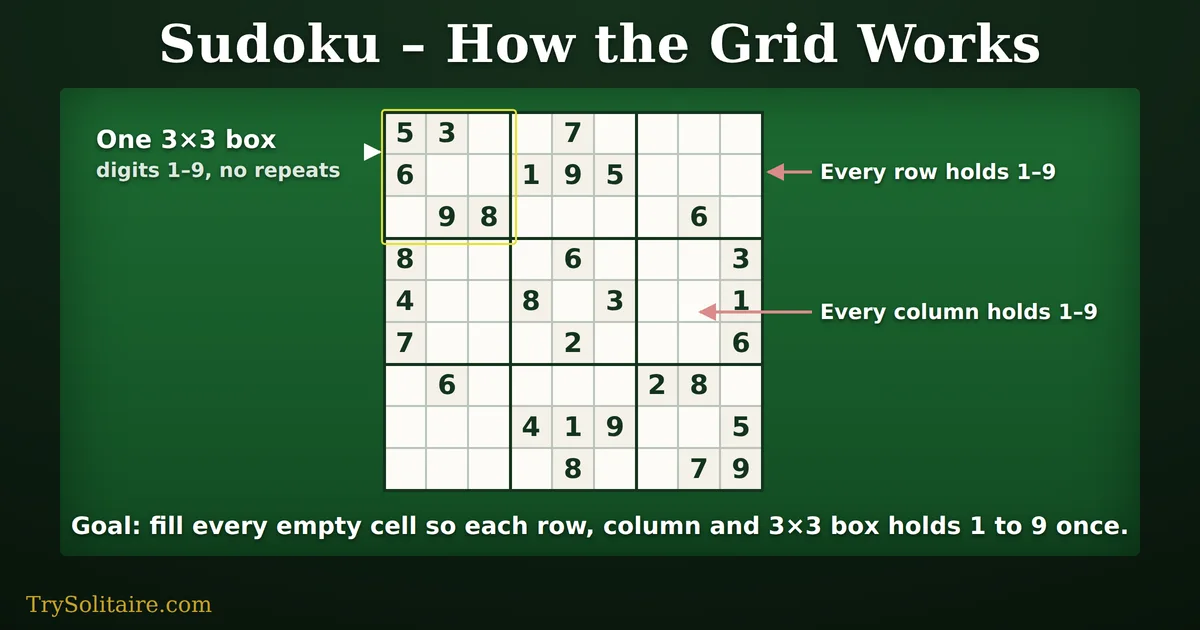
Goal: fill every empty cell so each row, column, and 3×3 box contains the numbers 1 through 9 exactly once.
The grid
- Cells: 81 in total, arranged 9×9.
- Rows and columns: nine of each. Each must contain 1–9 with no repeats.
- Boxes: nine 3×3 sub-grids. Each must contain 1–9 with no repeats.
- Givens: the puzzle starts with some cells filled in. Those don't change.
Rules
- No row repeats. Each digit 1–9 appears exactly once per row.
- No column repeats. Same rule, applied vertically.
- No 3×3 box repeats. The grid breaks into nine 3×3 boxes; each box gets one of each digit.
- One unique solution. Every well-formed Sudoku has exactly one valid completion. Pure logic — no guessing required.
Difficulty Levels
The standard control for Sudoku difficulty is the number of givens. Fewer givens means more deduction, more advanced techniques, and longer solve times.
| Level | Givens | Techniques needed | Typical solve time |
|---|---|---|---|
| Beginner (with Master Sudo) | ~42–46 | Scanning, single candidate | 5–15 min |
| Easy | 36–40 | Scanning, single position | 5–10 min |
| Hard | 28–32 | Naked pairs, hidden pairs, pointing pairs | 15–30 min |
| Evil | 24–27 | Box-line reduction, triples, X-wing | 30–60 min |
The minimum number of givens for a unique-solution Sudoku is 17, proven by McGuire, Tugemann & Civario (2014) in a published exhaustive computer search. Below 17 clues, multiple solutions always exist.
Play a level directly: Easy, Hard or Evil.
Solving Techniques
Beginner techniques
- Scanning. For each digit 1–9, check which rows, columns, and boxes already contain it. Empty cells in those groups can't take that digit.
- Single candidate. A cell where only one digit doesn't conflict with its row, column, or box must be that digit.
- Single position. A digit that fits in only one cell within a row, column, or box belongs there.
- Elimination with notes. Use pencil marks to track candidates per cell. Cross out candidates as you fill in digits. When a cell has only one candidate left, fill it.
Intermediate techniques
- Naked pairs. If two cells in a row, column, or box can only hold the same two digits, those digits can be removed from every other cell in that group.
- Hidden pairs. If two digits can only appear in the same two cells of a row, column, or box, every other candidate can be removed from those cells.
- Pointing pairs. When a digit's only candidates within a 3×3 box all sit in the same row or column, that digit can be removed from the rest of that row or column.
Advanced techniques
- X-wing. A digit appears as a candidate in exactly two cells of two rows, and those cells line up in the same two columns. The digit can be eliminated from every other cell in those columns.
- Swordfish. X-wing extended to three rows and three columns.
- Coloring & chains. Track candidate links across the grid. If a chain forces a contradiction, eliminate the candidate at the chain's start.
Features In This Version
- Notes mode. Click the pencil icon to enter notes mode. Mark candidate digits in cells. Add or remove at any time.
- Hints. Select an empty cell and click the lightbulb. The hint fills in the correct number for that cell, and the game counts the hints you use.
- Validate. Check your current state without revealing the solution. Conflicts are highlighted; correct cells stay clean. Mistakes only count when you validate.
- Undo & redo. Step backward and forward through your solving history. No penalty.
- Timer. Auto-starts on first input. Pause when interrupted.
- Daily challenge. A new puzzle every day, identical for every player worldwide. Build a streak by solving each one.
- Auto-save. Your progress saves to local storage. Close the tab; return later; pick up where you left off.
A Short History
The 9×9 grid traces back through Latin squares to Leonhard Euler in the 18th century, but modern Sudoku is younger than that. American architect Howard Garns designed it as Number Place, first published in Dell Pencil Puzzles & Word Games in May 1979. Japanese puzzle publisher Nikoli picked it up in 1984 under the name Sūji wa dokushin ni kagiru (数字は独身に限る — "the digits must remain single"), eventually shortened to Sudoku.
The international wave came in November 2004, when New Zealand puzzle enthusiast Wayne Gould convinced The Times of London to publish his computer-generated Sudoku puzzles. Within a year the format had spread to thousands of newspapers worldwide. The first World Sudoku Championship was held in Lucca, Italy, in March 2006.
About This Version
This Sudoku runs in your browser — free, no download, no sign-up. Choose your difficulty before each puzzle. Install as an app on your phone or computer; once installed it works offline. Beginner mode includes Master Sudo, who walks you through each technique step by step. Daily challenges, statistics by difficulty, and undo and redo are included.
Prefer pen and paper? Grab free printable Sudoku puzzles at every difficulty level — Easy through Expert, no sign-up.
Other Puzzles to Try
- 2048 — slide and merge tiles to reach 2048
- Mahjong Solitaire — match free tile pairs to clear the layout
- Klondike Solitaire — the classic Microsoft Solitaire
- FreeCell — every card visible, almost every deal winnable
Frequently asked questions
Is every Sudoku puzzle solvable?
Yes. Every puzzle we serve has exactly one unique solution and can be solved by pure logic — no guessing. The minimum number of givens needed for a unique solution is 17, proven by McGuire, Tugemann & Civario (2014). If you feel like you have to guess, there's a technique you haven't found yet.
How do I get better at Sudoku?
Practice consistently and learn techniques in order. Start with Beginner mode where Master Sudo walks you through each step. Move to Easy once scanning and single-candidate feel automatic. Reach Hard by adding naked pairs and hidden pairs. Evil needs pointing pairs and box-line reduction on top, and sometimes a naked triple. Use notes mode at every level above Beginner.
Do I need any math?
No. Sudoku uses digits 1–9 but no arithmetic. The same logic works with letters, symbols, or colors — numbers are just convenient. Every move comes from the rules: no repeats in a row, column, or 3×3 box.
What's the difference between hints and validation?
A hint fills in the correct number in the cell you select, and the game counts each one. Validation just checks your current state for conflicts without revealing the solution. Validation also enables the mistake counter, so feel free to experiment without consequence until you decide to check.
Where does Sudoku come from?
American architect Howard Garns designed the modern puzzle as Number Place, first published in Dell Pencil Puzzles & Word Games in May 1979. Japanese publisher Nikoli picked it up in 1984 and named it Sudoku. The global breakout came in November 2004 when The Times of London began publishing Wayne Gould's computer-generated puzzles. The first World Sudoku Championship was held in Lucca, Italy, in 2006.