


Spider is a two-deck solitaire played across ten tableau columns. The goal is to build eight complete King-to-Ace runs in the same suit; each completed run lifts off the board to a foundation. Three difficulty levels — 1, 2, and 4 suits — with a steep curve between them. Free in your browser, no sign-up. Works offline once the page has loaded.
Goal: Build eight complete King-to-Ace sequences in the same suit. When a sequence is complete, it auto-lifts to the foundation area.
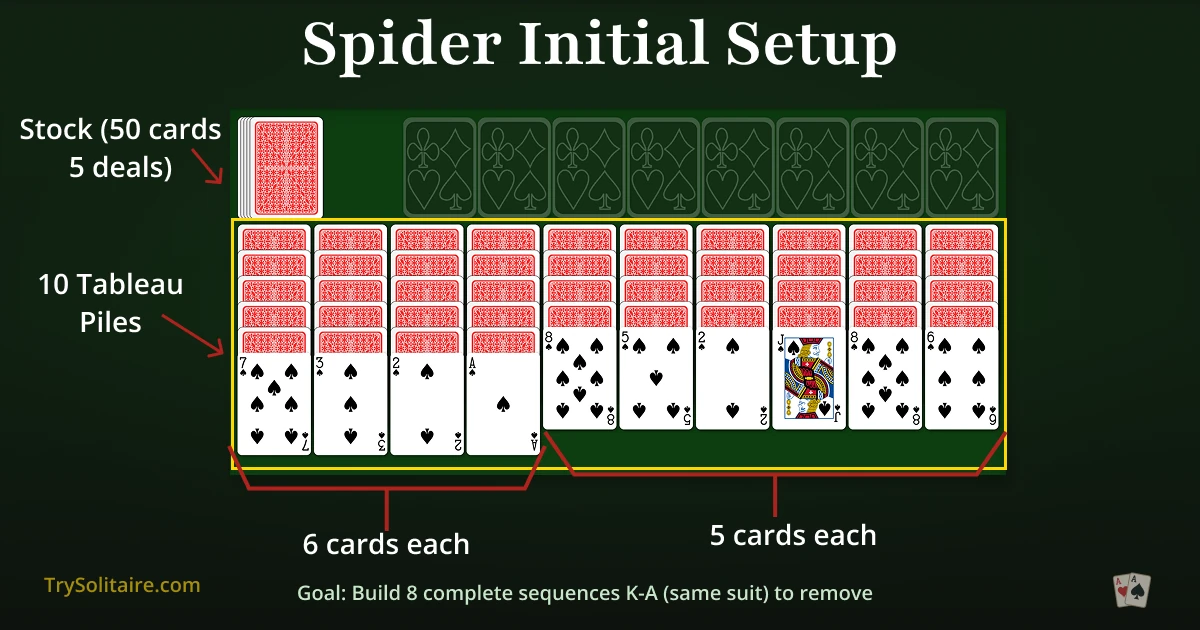
The deck is always 104 cards. What changes is how many suits the cards span; rules are identical across the three.
| Mode | Suits in play | Our players, Aug 2026 | Recommended for |
|---|---|---|---|
| 1 Suit | Spades only (×2 decks) | 59.4% | Learning the rules |
| 2 Suits | Spades + Hearts (×2) | 33.0% | Most players |
| 4 Suits | All four suits (×2) | 24.2% | The standard challenge |
The win rates come from our August 2026 player report. They count every Spider game started on TrySolitaire in August 2026, and a game left unfinished counts as not won. We know of no solver study that gives a figure for how many Spider deals can be won, so this page gives only what our players did.
Until 3 October 2026, our 2- and 4-suit games let a run of mixed suits move as one unit, which the standard rules do not allow. The 2- and 4-suit figures above come from that easier game. The game now follows the standard rule, so expect lower win rates in our later reports.
Pick 1, 2, or 4 suits before you start. Unlimited undo, statistics tracked per difficulty, and a daily challenge that gives the same deal to everyone that day so you can compare times. Install it as an app from your browser menu to play offline.
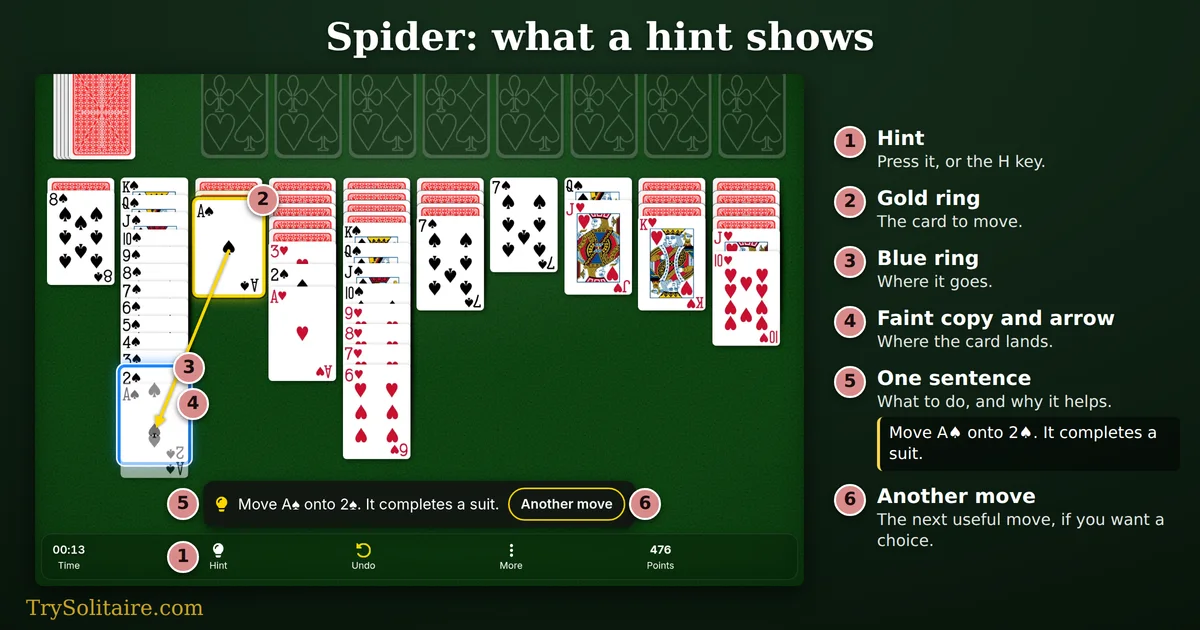
Stuck? Press Hint, or the H key. The game shows a useful move, with an arrow and one sentence that says why. The hint looks ahead with a solver that sees the face-down cards, and when the solver finds a win, the hint follows it. A hint costs no points.
No. Unlike Klondike, Spider has no published solver figure, so nobody knows how many deals can be won. In August 2026, TrySolitaire players won 59.4% of 1-suit games, 33.0% of 2-suit games and 24.2% of 4-suit games, counting unfinished games as not won. The 2- and 4-suit games then still let mixed-suit runs move as one unit; we corrected that rule in October 2026.
All three modes use two decks (104 cards) and identical rules. 1-suit uses only spades; 2-suit adds hearts; 4-suit uses all four suits. The harder modes don't change the rules — they just make moving sequences harder, since you can only move groups of cards in the same suit.
An empty column lets you temporarily move out cards to clean up sequences underneath. Without empty columns, mixed-suit groups are stuck — you can only move the top card. Each empty column you can hold open dramatically increases what you can rearrange.
Yes, but it's hard. In August 2026, TrySolitaire players won 24.2% of the 4-suit games they started (unfinished games count as not won), in a version that still let mixed-suit runs move as one unit. Expose face-down cards before a deal, and build same-suit runs when you can. You may deal with a column empty, but filling it first is usually wise.
Spider entered the published canon of patience games around 1949. The name is commonly attributed to its eight foundations — like a spider's eight legs. Microsoft included Spider Solitaire in the Windows 98 Plus! add-on pack (1998), then bundled it with Windows ME (2000) and most subsequent Windows releases that shipped pre-installed games.