Play Yukon Solitaire — Seven Columns, All 52 Cards Dealt, No Stock
Yukon is a Klondike sibling with two big differences: all 52 cards are dealt at the start, and there is no stock pile. You play with what's on the table. Any face-up card can be picked up along with all the cards beneath it — even if the cards beneath aren't in order. That single rule turns Yukon into a longer, deeper puzzle than Klondike. Free in your browser, no sign-up. Works offline once the page has loaded.
How Do You Play Yukon?
Goal: build all four foundations from Ace to King by suit.
Setup
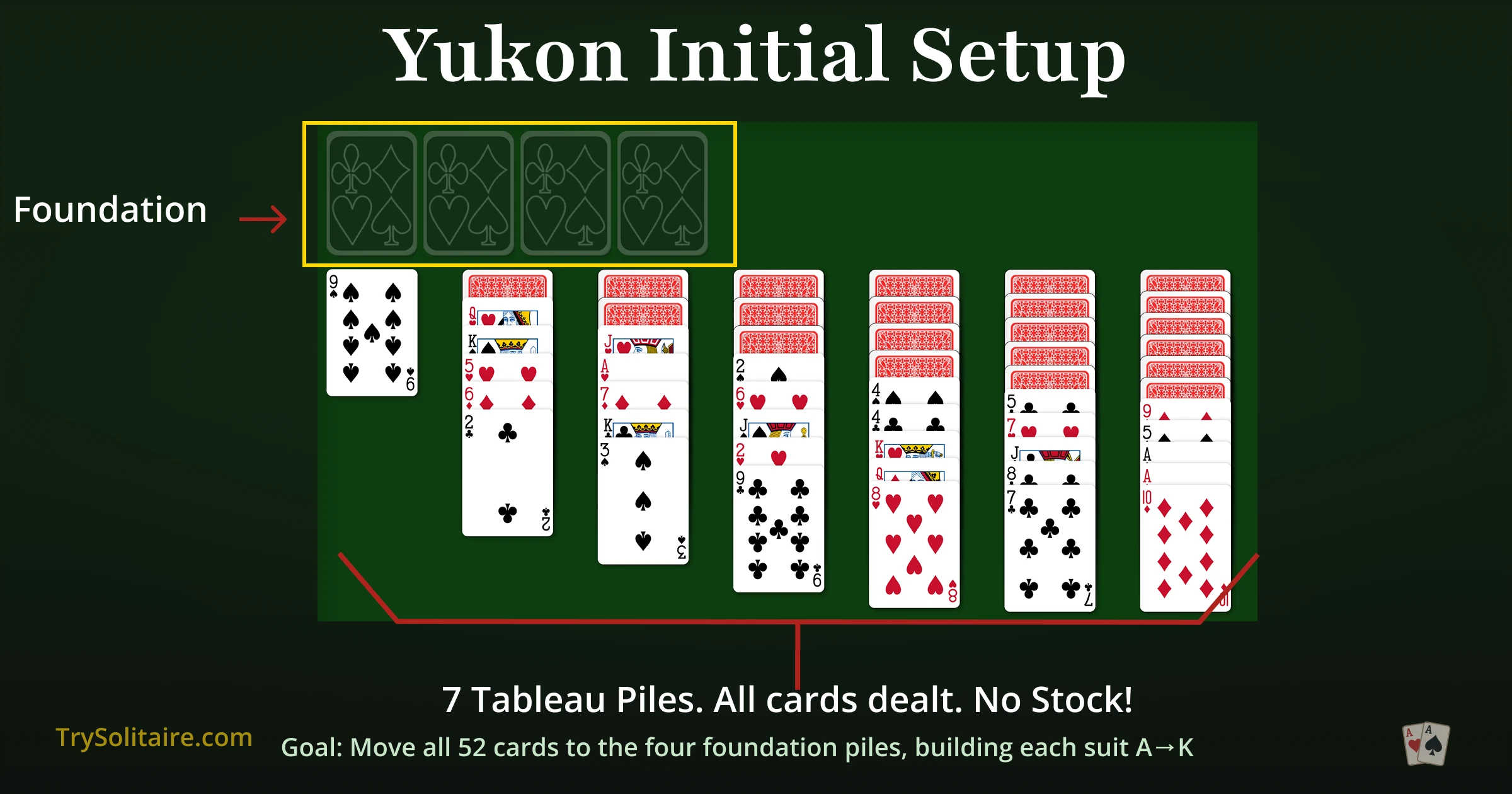
- Tableau: seven columns. The first column has 1 card, the second 6, the third 7, and so on up to 11 in the seventh. The first column is a single face-up card. In the other six, the top five cards are face-up and the cards under them are face-down: 21 face-down and 31 face-up in all.
- No stock, no waste. Everything you'll use is on the table from the first move.
- Foundations: four empty piles, top right. Build up by suit, Ace to King.
Rules
- Build tableau columns down by alternating color. A black 9 goes on a red 10.
- Move any face-up card with everything beneath it as a single group, regardless of order. This is the defining Yukon rule. The card you pick must be a legal placement on the destination, but the cards beneath it don't need to be in sequence.
- A face-down card turns face-up when the cards above it move away.
- Only Kings (or any group with a King at the bottom) can fill an empty column.
- Foundations build up by suit, Ace to King. A card on a foundation stays there; you cannot move it back to the tableau.
Yukon vs Klondike
Same family, different rules. Yukon is harder by some metrics, easier by others.
| Aspect | Klondike | Yukon |
|---|---|---|
| Tableau columns | 7 | 7 |
| Stock pile | 24 cards | None |
| Hidden cards | 21 face-down | 21 face-down |
| Group moves | Only properly ordered alternating-color sequences | Any face-up card plus everything beneath it |
| Empty columns | King only | King only |
Both games hide 21 cards at the start. Yukon hides nothing else: with no stock, the other 31 cards are face-up from the first move. The lift-anything rule gives you huge mobility but also more decisions, and that is where the skill lies.
What's the Best Yukon Strategy?
- Plan before you move. 31 cards are visible from the start. Trace the chain you want to build before committing to the first move, and favour moves that turn over a face-down card.
- Empty a column early. Empty columns are the most powerful tool for re-arranging chains. Aim to clear at least one column in the first few moves.
- Save Aces and 2s for when they help. Sending an Ace to the foundation is final. Hold off if the Ace is sitting on top of a card you need to move first.
- Watch the Kings. Only Kings fill empty columns. If all four Kings are buried at the bottom of long stacks, the empty-column game is over.
- Move groups, not single cards. The any-card-with-everything-beneath rule is Yukon's superpower. A long messy stack on top of a target card can be moved as one unit if the top card is a legal placement.
- Foundation timing. Don't rush 4s, 5s, 6s up. Mid-rank cards are useful for building tableau sequences and worth keeping in play longer than corner ranks.
A Short History
Yukon dates to the same Yukon Klondike Gold Rush era (1896–1899) as its more famous sibling. The name reflects the place rather than a specific person. The no-stock game has been documented in patience anthologies since the early 20th century. Microsoft included Yukon in Microsoft Entertainment Pack 4 (1992) but didn't add it to the Solitaire Collection that ships with modern Windows.
About This Version
This Yukon runs in your browser — free, no download, no sign-up. Install as an app on your phone or computer; once installed it works offline. Unlimited undo, statistics, and a daily challenge that gives every player the same deal that day so you can compare times.
Other Solitaire Games to Try
- Klondike — the seven-column classic with a stock pile
- Spider — two decks, ten columns, suit-based sequences
- FreeCell — every card visible, four free cells for temporary storage
- Scorpion — Spider's harder cousin, no stock pile either
For deeper strategy and the full history of Yukon, see our Yukon guide.
Frequently asked questions
What's the main difference between Yukon and Klondike?
Yukon has no stock pile: all 52 cards go to the tableau, 21 face-down and 31 face-up. The other big difference is the move rule: in Yukon you can pick up any face-up card together with every card beneath it, regardless of order. In Klondike, only properly ordered alternating-color sequences move as groups.
Are all Yukon games winnable?
Not all. No one has published a solvability study for Yukon, so treat any exact win rate as a guess. Twenty-one cards start face-down, so some luck remains. But the lift-anything rule gives you many ways to dig those cards out, and careful play wins far more deals than hasty play.
Can any card fill an empty column?
No. Only a King — or any group with a King at the bottom — can fill an empty tableau column. The same rule as Klondike. This is why losing all four Kings to deep buried positions usually ends the game.
How is Yukon scored?
There's no built-in score in our version. You either complete all four foundations (win) or run out of moves (loss). The challenge is solving the deal, not maximizing points.
Where does the name come from?
From the Yukon Klondike Gold Rush of 1896–1899 in northwestern Canada. Yukon and Klondike share the regional name and the era. The variant was documented in patience anthologies in the early 20th century and included in Microsoft Entertainment Pack 4 (1992).