Play Golf Solitaire — Seven Columns, ±1 Rank Matching, Score Like Golf
Golf Solitaire is a fast single-deck patience built around a 35-card tableau and a single rule: play any uncovered card one rank above or below the top of the waste. Suits are ignored. The ranks wrap, so an Ace plays on a King and a King plays on an Ace. What gives Golf its bite is the tableau: only the last card of a column is live, so a card buried under four others waits for those four to go, and you have 16 stock cards and no redeal to spare. Scoring follows the sport: lower is better, and a negative score is excellent. Free in your browser, no sign-up. Works offline once the page has loaded.
How Do You Play Golf Solitaire?
Goal: remove all 35 tableau cards by playing them onto the waste. Score as few points as possible — negative is better than zero.
Setup
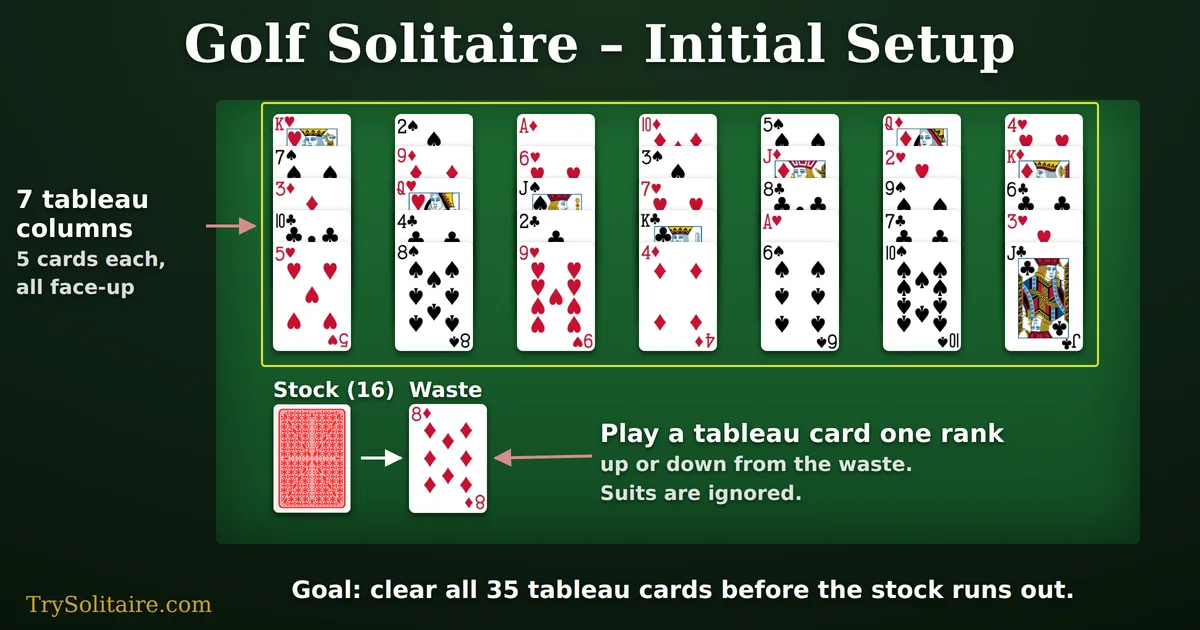
- Tableau: seven columns of five cards each (35 cards), all face-up.
- Stock: the remaining 17 cards, face-down to the side. One turns over to start the waste, so 16 stay in the stock.
- Waste: a single pile next to the stock. The first card is dealt face-up at the start.
- No foundations. Cards leave play directly onto the waste.
Rules
- Click any uncovered tableau card whose rank is one above or one below the top of the waste. Suits are ignored.
- The ranks wrap. An Ace plays on a King and a King plays on an Ace, so King–Ace–2 is a legal run in either direction and every rank has two neighbours.
- Only the bottom card of each column is in play. Removing one exposes the card above it.
- When no tableau card matches, click the stock to flip the next card to the waste.
- The round ends when no playable move exists and the stock is empty, or when every tableau card has been removed.
Scoring — Lower Is Better
Golf Solitaire is named after the sport, and the scoring follows: every card you couldn't clear is one stroke against you, every stock card you didn't need is one under par.
| Outcome | Score |
|---|---|
| Each tableau card remaining at end | +1 point |
| Cleared the tableau exactly as the stock ran out | 0 — par |
| Each unused stock card after clearing the tableau | −1 point |
A −5 round means you cleared the tableau with five stock cards still face-down — five strokes under par, the equivalent of a great golf round. Most rounds end with cards left in the tableau (positive score). A consistent average below +10 over many rounds is strong play.
What's the Best Golf Strategy?
- Plan the long chain before you start. All 35 tableau cards are visible. Trace the longest sequence you can build from the current waste card before making any moves. Five seconds of scanning beats five minutes of regret.
- Clear the tallest columns first. Long columns are your biggest obstacle. A buried card under four others requires four moves to reach. Reduce them early so they don't strand at the end.
- Keep the live ranks spread out. With the wrap in play every rank connects in both directions, so no card is a dead end. What strands you is a narrow board: if the seven live cards cluster around one value, the next stock card decides the round for you.
- Read the wrap before you draw. Because the ends of the rank order join, a run can pass through King and Ace and come out the other side. That link often joins two chains you had read as separate, and it is the one most players miss.
- Use the stock as a pivot, not a default. Each stock draw becomes a card you can't play, so it's a free point the wrong way. Exhaust tableau plays before flipping.
- Watch for stacked pairs. Two cards of the same rank back to back in one column cannot follow each other. You play one, go elsewhere, and come back with a neighbouring rank. Spot those columns early and plan the return trip.
Golf vs TriPeaks
The two share the ±1 rank matching and the Ace–King wrap. They differ on layout, on how many cards you can reach at once, and on how you score.
| Aspect | Golf | TriPeaks |
|---|---|---|
| Layout | 7 columns × 5 cards | 3 overlapping pyramids + bottom row |
| Tableau cards | 35 | 28 |
| Stock once the first card is dealt | 16 cards | 23 cards |
| Cards playable at once | 7 — one per column | Up to 10 uncovered |
| Scoring | Lower is better (golf style) | Streak multiplier (higher is better) |
A Short History
Golf Solitaire dates to the early 20th century, when the golf-themed scoring caught on among patience players who wanted a quick round between tasks. The base mechanic — play one rank up or down on a single waste pile — predates Golf in older patience anthologies, but the seven-column layout and the lower-is-better scoring are what define the modern game. The variant has appeared in Microsoft solitaire collections and most modern multi-game packages, though Microsoft has not made Golf one of their headline solitaire games.
About This Version
This Golf runs in your browser — free, no download, no sign-up. Install as an app on your phone or computer; once installed it works offline. Unlimited undo, statistics, and a daily challenge that gives every player the same deal that day so you can compare scores.
Other Solitaire Games to Try
- TriPeaks — three-pyramid version with the same wrap and streak scoring
- Pyramid — pair to 13 instead of ±1, much harder
- Klondike — the seven-column classic with foundations
- FreeCell — every card visible, almost every deal winnable
Frequently asked questions
Can Aces play on Kings in Golf Solitaire?
Yes. In this version the ranks form a loop: an Ace plays on a King and a King plays on an Ace, exactly as a 6 plays on a 7. Traditional table Golf is usually played without that wrap, and it is a much harder game for it — Aces stranded on 2s and Kings on Queens are what kill those rounds. If you learned Golf at a table, expect longer chains here.
What's a good score in Golf Solitaire?
A score of 0 means you cleared the tableau exactly as the stock ran out — par. A negative score means you cleared with stock cards still face-down — under par. Most rounds end with 5–15 cards left in the tableau (positive score). A consistent average below +10 across many rounds is strong play.
Are all Golf Solitaire games winnable?
No, but most are. Our exhaustive solver cleared 92.6% of 5,000 random deals under the rules played here — 4,629 of the 4,998 the search decided, with 2 deals left undecided at the cut-off. That figure is a ceiling for perfect play, not a human win rate: it assumes perfect play with every branch searched before the first move, which no one does by eye. Expect to clear far fewer than nine in ten, and treat the card count at the end as the real measure.
How is Golf different from TriPeaks?
Both use ±1 rank matching with suits ignored, and both wrap Ace to King. Golf deals seven columns of five cards (35 in all), leaves 16 in the stock, and scores golf-style so lower is better. TriPeaks deals three overlapping pyramids (28 cards), leaves 23 in the stock, and scores with a streak multiplier so higher is better. Golf is the tighter game: more cards to clear and fewer draws to clear them with.
Where does Golf Solitaire come from?
Golf Solitaire dates to the early 20th century, named for the golf-style scoring. The ±1 matching mechanic predates the variant in older patience anthologies, but the seven-column layout and the lower-is-better score are what make the modern game distinct. It's been included in many digital solitaire packages over the decades.