Play TriPeaks Solitaire — 3 Peaks, ±1 Rank Matching, Streak Scoring
TriPeaks is a fast, sequence-driven solitaire built around three overlapping pyramids and a single 52-card deck. You clear pyramid cards by matching them one rank above or below the top of the waste — suits don't matter. Around 90% of deals are believed to be winnable with optimal play, well above Klondike's ~82%, which is why TriPeaks feels generous while still rewarding planning. Free in your browser, no sign-up. Works offline once the page has loaded.
How Do You Play TriPeaks Solitaire?
Goal: remove all 28 pyramid cards by matching them ±1 rank from the top of the waste pile.
Setup
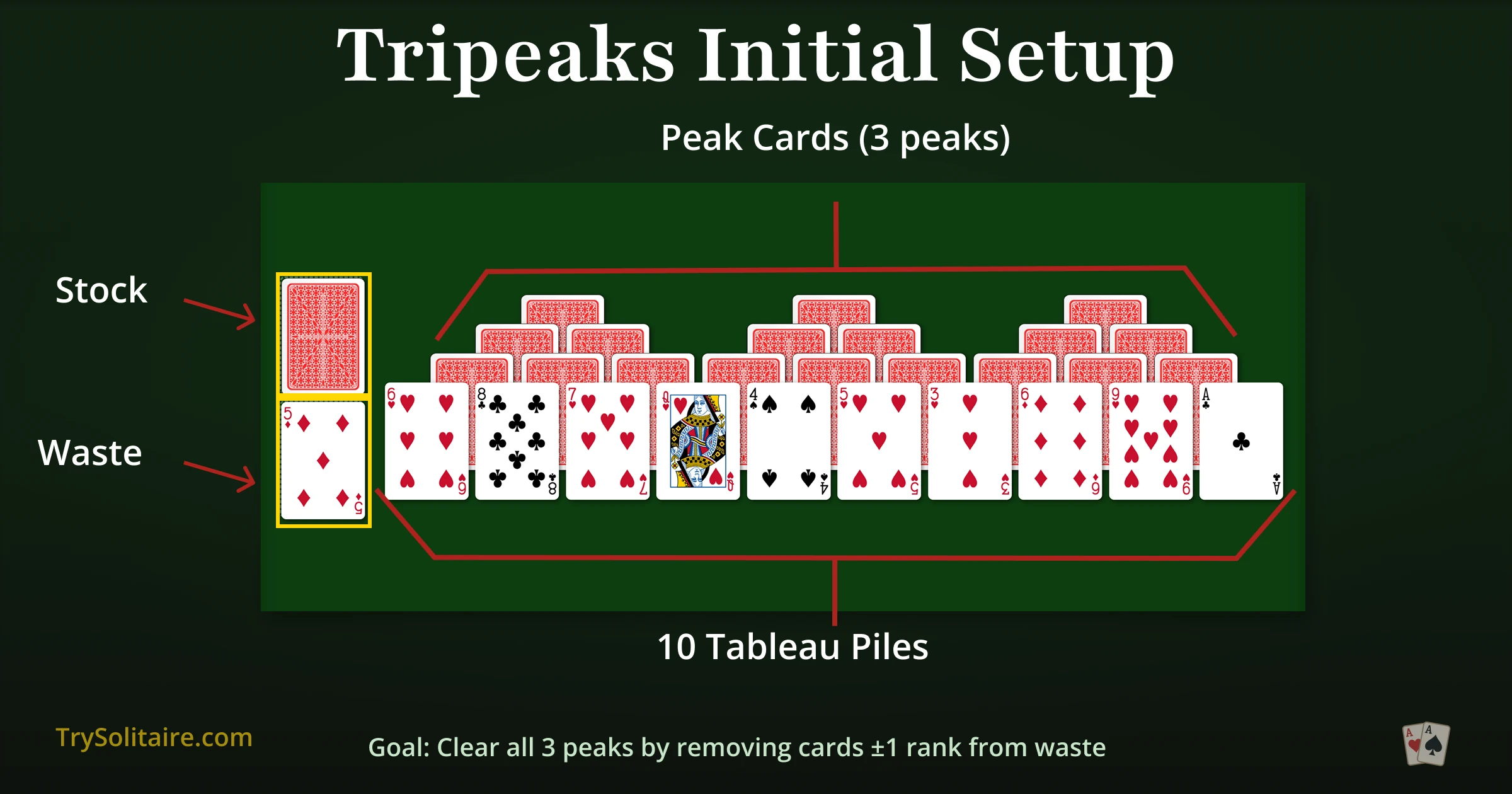
- Three pyramids: 28 cards in three overlapping triangles. Each pyramid has 1 peak card, 2 middle-row cards, and 3 base-row cards. Pyramids share no cards; they overlap visually only.
- Bottom row: 10 face-up cards along the base of the three pyramids, in play from the first move. They cover most of the base-row cards above them.
- Stock: 23 cards face-down in the bottom-left. Click to flip the next to the waste.
- Waste: a single pile to the right of the stock. Only the top card is in play. The first waste card is dealt face-up at the start.
Rules
- Click any uncovered pyramid card whose rank is one above or one below the top of the waste. Suits are ignored.
- Ace–King wrap. King connects to Ace, Ace connects to 2, in either direction. Without the wrap, edge ranks would dead-end too often.
- A pyramid card is playable only when no other card overlaps it. The bottom row covers pyramid base rows; base rows cover middle rows; middle rows cover the peaks.
- When no pyramid card matches, click the stock to flip the next card to the waste. There is no recycle — once the stock empties, you keep playing with the top of the waste but no further draws.
- You win when all 28 pyramid cards are cleared. You lose if no playable move exists and the stock is empty.
Scoring
TriPeaks rewards sequences far more than individual cards. Most of your final score comes from one or two long streaks, not many short runs.
| Event | Points |
|---|---|
| Pyramid card cleared | 50 × current streak multiplier |
| Streak multiplier | Starts at 1, +1 per consecutive card, resets to 1 on stock draw |
| Peak cleared (×3) | +100 each |
| Game won | +1,000 |
| Card left in stock | −25 each |
A 10-card streak alone scores 50 + 100 + 150 + 200 + 250 + 300 + 350 + 400 + 450 + 500 = 2,750 points. Spread the same ten cards across five short streaks and you get 5 × (50 + 100) = 750 — less than a third. Streak management is the central skill.
What's the Best TriPeaks Strategy?
- Always extend before you draw. Every stock draw resets your streak. Before clicking the stock, scan every uncovered pyramid card to confirm none is one rank away from the current waste.
- Prefer plays that uncover new cards. When two cards are both legal, play the one that exposes the most new cards underneath. A second-row card usually uncovers two cards below it; a base-row card uncovers fewer.
- Look ahead before committing direction. When you can play either a 6 or an 8 on the current 7, the better choice is whichever continues longer. Five seconds of scanning beats five seconds of regret.
- Work the three peaks evenly. Clearing one peak entirely while ignoring the others usually leaves you stuck — the remaining cards cluster in the same rank range and starve your sequences.
- Mind the edge ranks. Aces and Kings only match two ranks each (2/Q for King, K/2 for Ace). When you draw an edge rank from stock, check whether the necessary continuation cards are visible before committing.
- Use Undo as a learning tool. Unlimited undo is part of the game. When two paths look close, take one — and if it dead-ends, undo and try the other.
A Short History
TriPeaks is credited to Robert Hogue, a Microsoft developer who designed it in the late 1980s. It first reached a wide audience in Microsoft Entertainment Pack 3 (1991), the third instalment of the Windows games collection that also introduced FreeCell, SkiFree, and Chip's Challenge. The game stayed niche for two decades, then returned to mainstream Windows in the Microsoft Solitaire Collection bundled with Windows 8 in 2012, alongside Klondike, Spider, FreeCell, and Pyramid.
About This Version
This TriPeaks runs in your browser — free, no download, no sign-up. Install as an app on your phone or computer; once installed it works offline. Unlimited undo, statistics, and a daily challenge that gives every player the same deal that day so you can compare times.
Other Solitaire Games to Try
- Klondike — the classic Microsoft Solitaire
- Spider — two decks, ten columns, suit-based sequences
- FreeCell — every card visible, almost every deal winnable
- Pyramid — single-pyramid cousin where pairs sum to 13
- Golf — similar ±1 matching with no wrap
For deeper strategy and the full history of TriPeaks, see our TriPeaks guide.