Play Pyramid Solitaire — Pair Cards That Sum to 13
Pyramid Solitaire is a single-deck patience built around a 28-card pyramid and a simple arithmetic rule: pairs of cards that add to 13 come off together. Aces count as 1, Jacks as 11, Queens as 12, and Kings as 13 — Kings clear alone. Most deals are unwinnable, which is the source of the game's reputation: a Pyramid win feels earned. Free in your browser, no sign-up. Works offline once the page has loaded.
How Do You Play Pyramid Solitaire?
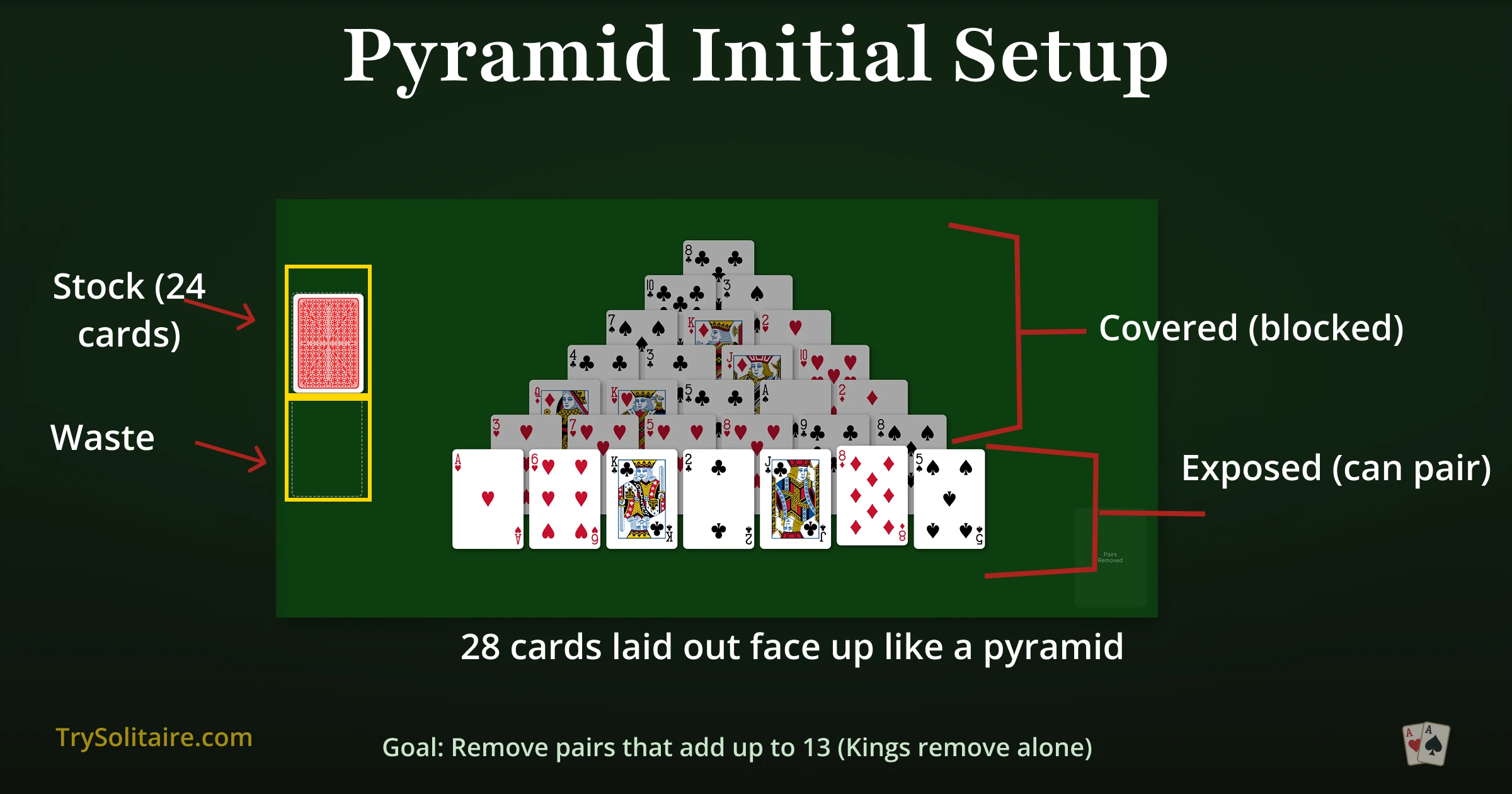
Goal: remove all 28 pyramid cards (and ideally the stock too) by pairing cards whose ranks add to 13.
Setup
- Pyramid: 28 cards in seven overlapping rows — 1 card on top, 7 on the bottom row.
- Stock: the remaining 24 cards face-down to the side.
- Waste: the top of the waste is in play. The first card is dealt face-up at start.
Card values
- Ace = 1
- 2–10 = face value
- Jack = 11, Queen = 12
- King = 13 — clears alone, no pair needed
Rules
- Remove pairs of cards whose ranks add to 13. Suits are ignored.
- A pyramid card is in play only when no card overlaps it. Each pyramid card is covered by the two cards in the row below.
- Kings are removed by themselves — single click, no pair needed.
- You can pair two pyramid cards, two waste cards never (only the top of the waste plays), or one pyramid card with the top of the waste.
- Click the stock to flip the next card to the waste. In our version the stock recycles up to three times.
The 13-Pairs at a Glance
| Pair | Ranks |
|---|---|
| 1 + 12 | Ace + Queen |
| 2 + 11 | 2 + Jack |
| 3 + 10 | 3 + 10 |
| 4 + 9 | 4 + 9 |
| 5 + 8 | 5 + 8 |
| 6 + 7 | 6 + 7 |
| 13 | King (alone) |
Memorising the six pair-rules turns most of the game into pattern recognition. Kings are free outs — clear them whenever they appear.
What's the Best Pyramid Strategy?
- Clear Kings as soon as you see them. Kings remove themselves, free up two cards underneath, and never lock you out. There's no reason to delay them.
- Work the pyramid before the stock. Every stock draw burns a card you may need later. Exhaust the pairs you can see in the pyramid before flipping.
- Watch for blocked pairs. If both 6s in the bottom row sit directly under the same 7, you can never reach the 7 — every pair-of-6 destroys that route. Spot these dead-ends early so you can route around them.
- Track which copies remain. Each rank has four copies. After a 6+7 pair, three of each remain. When a rank's last copy is buried under a chain you can't reach, the cards above it are stuck.
- Open the pyramid evenly. Removing only the right half of the pyramid leaves the left half blocked by cards you've already played past. Spread your pairs across the pyramid to expose more options.
- Save useful waste cards. If the current waste card is a 6 and you can see two 7s in the pyramid, don't immediately pair the 6 with the easier match — the harder 7 may need it.
A Short History
Pyramid Solitaire is one of the older patience games in the printed canon. It appears in Lady Adelaide Cadogan's Illustrated Games of Patience (1870s) under the name Pile of Twenty-Eight, with the same 28-card pyramid and the same pair-to-13 rule. It went mainstream when Microsoft included Pyramid in Microsoft Entertainment Pack 4 (1992) alongside Yukon, and again in the Microsoft Solitaire Collection bundled with Windows 8 (2012).
About This Version
This Pyramid runs in your browser — free, no download, no sign-up. Install as an app on your phone or computer; once installed it works offline. Three stock recycles, unlimited undo, statistics, and a daily challenge that gives every player the same deal that day so you can compare results.