Play Spider Solitaire — 10 Columns, King-to-Ace Runs
Spider is a two-deck solitaire played across ten tableau columns. The goal is to build eight complete King-to-Ace runs in the same suit; each completed run lifts off the board to a foundation. Three difficulty levels — 1, 2, and 4 suits — with a steep curve between them. Free in your browser, no sign-up. Works offline once the page has loaded.
How Do You Play Spider?
Goal: Build eight complete King-to-Ace sequences in the same suit. When a sequence is complete, it auto-lifts to the foundation area.
Setup
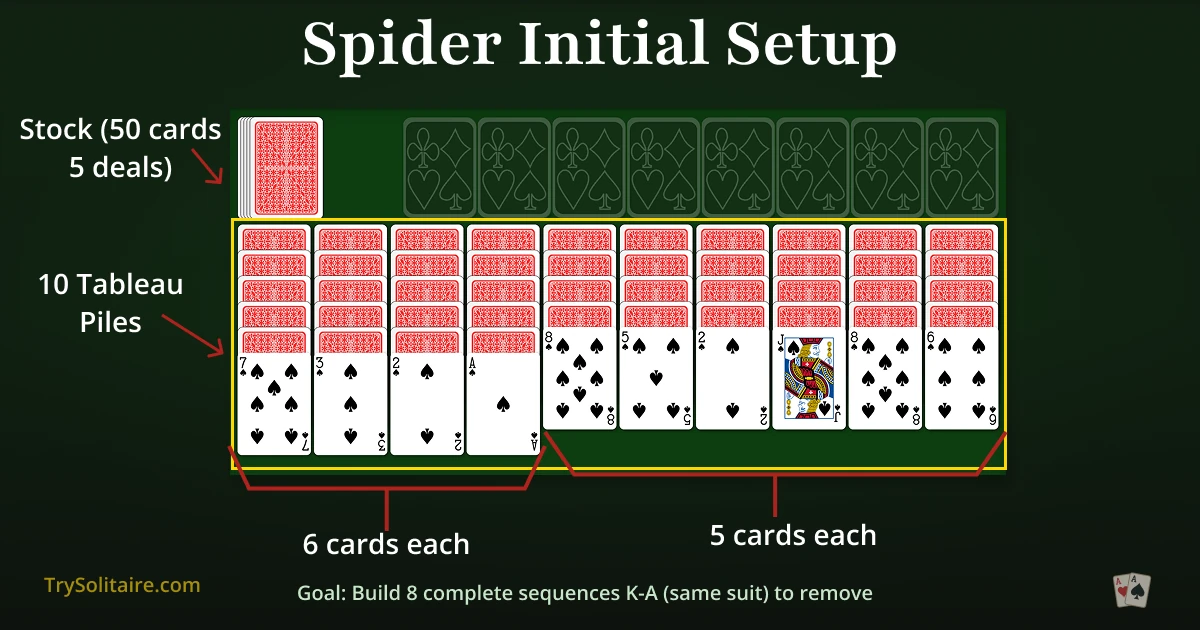
- Tableau: ten columns dealt face-down with the top card face-up. First four columns hold six cards; the last six hold five.
- Stock: 50 cards — five additional deals of ten (one card per column). Cannot deal if any column is empty.
- Foundations: eight slots, filled automatically by completed King-to-Ace runs in the same suit.
Rules
- Build tableau columns down by rank, any suit: King → Queen → Jack ... → Ace. Suit only matters when you move sequences.
- Move a single card or a same-suit sequence as a unit. Mixed-suit sequences move only one card at a time.
- Any card can fill an empty column.
- Click the stock to deal one card to every column. The stock cannot deal if any column is empty.
- Complete King-to-Ace runs in one suit lift to the foundations automatically.
1, 2, or 4 Suits — How They Differ
The deck is always 104 cards. What changes is how many suits the cards span; rules are identical across the three.
| Mode | Suits in play | Practical win rate | Recommended for |
|---|---|---|---|
| 1 Suit | Spades only (×2 decks) | ~95% with care | Learning the rules |
| 2 Suits | Spades + Hearts (×2) | ~30–40% with skill | Most players |
| 4 Suits | All four suits (×2) | ~5–15% with skill | The standard challenge |
The 4-suit range is wide because Spider has no peer-reviewed solvability study to anchor it (unlike Klondike at ~82%). Skilled play is generally accepted to win between 5% and 15% of 4-suit deals.
What's the Best Spider Strategy?
- Empty columns are gold. They let you reorganise mixed-suit groups into clean same-suit sequences. Every empty column you can hold open extends what you can move.
- Expose face-down cards before forcing a deal. Each face-down card flipped is information. Once the stock is dealt, your options narrow sharply.
- Build same-suit whenever you have the choice. Mixed-suit columns look fine but cost mobility — you can only move the top card from a mixed group.
- Plan past the stock. The stock will deal five times. Before each deal, fill every column so the new cards land in useful places, not on top of work you've just done.
About This Version
Pick 1, 2, or 4 suits before you start. Unlimited undo, statistics tracked per difficulty, and a daily challenge that gives the same deal to everyone that day so you can compare times. Install it as an app from your browser menu to play offline.
Other Solitaire Games to Try
- Klondike — the classic Microsoft solitaire
- FreeCell — every card visible
- Spiderette — single-deck Spider on seven columns
- Scorpion — Spider's harder cousin, no stock
- Yukon — all cards face-up