Cribbage is a two-player game of counting to fifteen, played in two stages: a fast round of card play called pegging, then a slower count of what each hand was worth. The scoring looks strange for about one game. After that it becomes the reason people keep playing it for fifty years.
Two players, a standard 52-card deck, aces low. Each player is dealt six cards.
You then each choose two cards to put face down into a fifth hand called the crib. The crib belongs to the dealer, who counts it at the end of the hand as a bonus. The deal alternates, so the crib is yours every other hand.
That single decision, which two cards to throw, is most of the skill in cribbage. You are building your own four-card hand while either feeding or starving your opponent's crib.
The non-dealer cuts the remaining deck and the dealer turns one card face up. This is the starter, and it acts as a fifth card in both hands and in the crib when the counting happens.
If the starter is a Jack, the dealer immediately pegs two points. This is called his heels. It is the only score that happens before a single card is played.
Starting with the non-dealer, players take turns laying one card face up in front of themselves and calling the running total aloud. Face cards count ten; aces count one. The total may never go past 31.
You score during this stage for:
Because 31 is a ceiling, not a target you must hit. When neither player can add a card without passing it, the total resets and play continues with the cards still in hand. A single hand often has two or three of these mini-rounds.
After pegging, each player picks their four cards back up and counts them together with the starter: five cards in total. The order is fixed and it matters:
The order decides close games. The first player to 121 wins the moment they reach it, so a non-dealer sitting on 115 can win before the dealer counts anything at all.
| Combination | Points | Note |
|---|---|---|
| Cards totalling fifteen | 2 | Every different combination counts separately |
| Pair | 2 | Three of a kind is 6; four is 12 |
| Run of three or more | 1 per card | Counted once for each way it can be made |
| Flush in your four cards | 4 | 5 if the starter matches the suit too |
| Flush in the crib | 5 only | All five cards must match; four does not score |
| Jack matching the starter's suit | 1 | His nob |
| Starter is a Jack | 2 to the dealer | His heels, scored at the cut |
| Reaching exactly 15 or 31 while pegging | 2 | During card play only |
| Go, or the last card | 1 | During card play only |
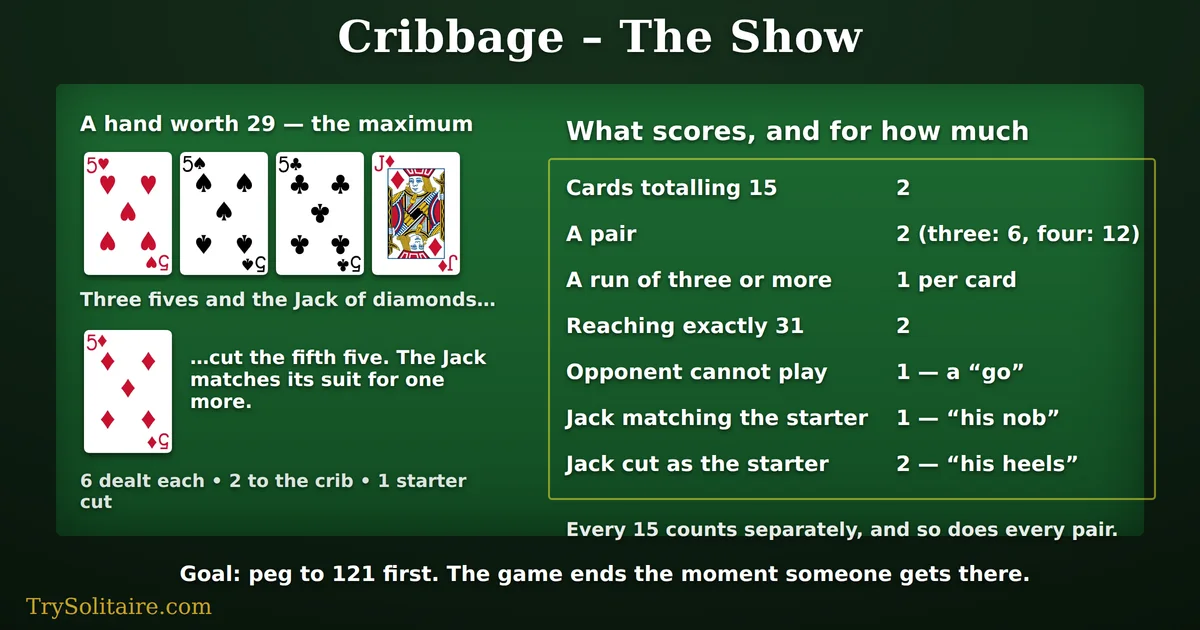
Take the 29 hand: three fives, the fourth five as the starter, and a Jack. Any two fives make ten, not fifteen. But each five pairs with the Jack, and there are four fives, giving four fifteens. Each group of three fives sums to fifteen as well, and there are four such groups. Four plus four is eight fifteens, or 16 points, before the four of a kind and his nob are added.
Judge every discard by two questions: what does it leave in my hand, and whose crib is it going to?
The Cribbage game here is the standard two-player game described on this page: six cards each, two to the crib, a cut starter with two for his heels, pegging to 31 with go and last card, then the show in non-dealer, dealer, crib order. Fifteens, pairs, runs, flushes and his nob are all counted for you, and the game ends the moment someone reaches 121.
You play against the computer at easy, medium or hard. It runs in the browser with no download and no sign-up, and you can install it as an app from your browser menu to play offline.
Any combination of cards totalling fifteen scores two. A pair scores two, three of a kind six, four of a kind twelve. A run of three or more scores one point per card. A flush scores four or five, and a Jack matching the starter's suit scores one.
The crib is a fifth hand made from the two cards each player discards. It belongs to the dealer, who counts it after both hands are counted. The deal alternates, so the crib passes back and forth between the players.
Twenty-nine. It needs three fives and the Jack of one suit, with the fourth five cut as the starter in the Jack's suit. That gives eight fifteens for sixteen, four of a kind for twelve, and his nob for one.
His nob is one point for holding the Jack of the same suit as the starter card. It is counted during the show, not during pegging. The related score, his heels, is two points to the dealer when the starter itself is a Jack.
121 points. The game ends the instant someone reaches that number, even in the middle of counting a hand. This is why the non-dealer counts first, and why the order of counting decides close games.
Low. An ace is worth one, both for making fifteen and for building runs. A run of Ace, two, three is valid; Queen, King, Ace is not. Face cards are all worth ten for counting, but keep their own rank in runs and pairs.
TrySolitaire has 301 card and puzzle games that run in your browser: Cribbage, Gin Rummy, Spades, Euchre, Hearts, Klondike, Spider, FreeCell, Sudoku, Mahjong and many more. No download and no sign-up. Install it as an app from your browser menu and it works offline.
Free • No sign-up • Works offline