Gin Rummy is a two-player game about sorting ten cards into groups and getting rid of what is left over. The rules take five minutes. The judgement of when to knock, rather than wait for gin, is what separates a good player from a lucky one.
Two players, a standard 52-card deck, ten cards each. One card is turned face up to start the discard pile, and the rest becomes the stock.
The first turn has its own small ritual. The non-dealer may take that upcard or pass. If they pass, the dealer may take it. If both pass, the non-dealer draws from the stock and normal play begins.
From then on every turn is the same two actions: draw one card, from the stock or the top of the discard pile, then discard one card. Your hand is always ten cards at the end of your turn. One rule constrains it: you may not discard the very card you just picked up from the discard pile.
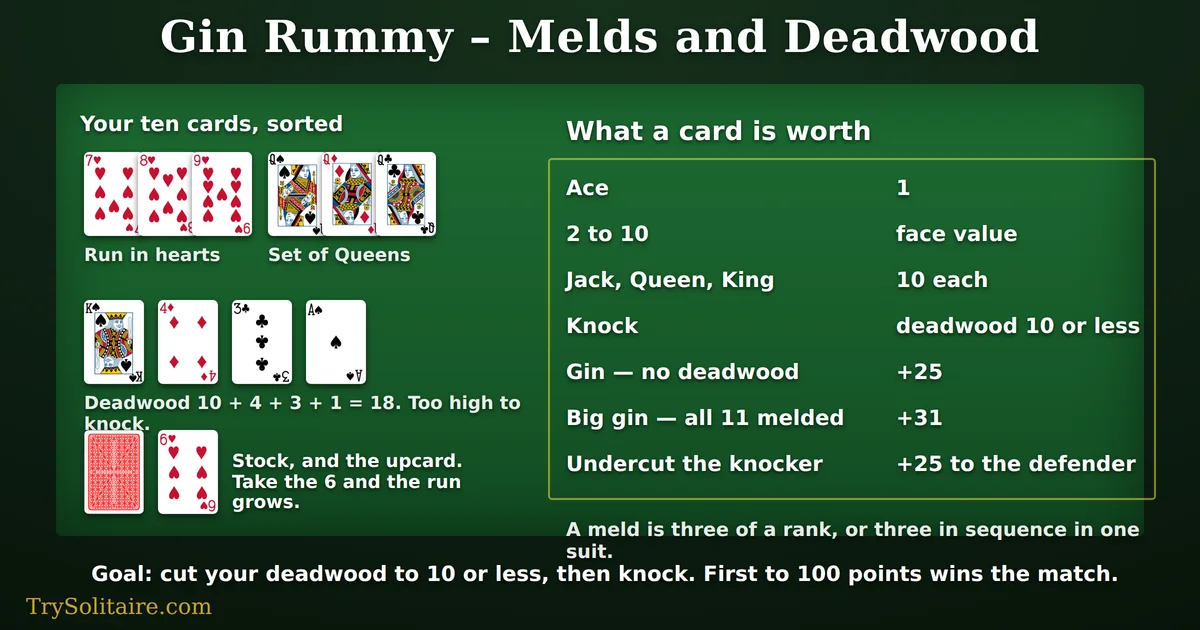
A meld is a group of three or more cards, and there are only two kinds:
Aces are low, so Ace, two, three of a suit is a valid run and Queen, King, Ace is not. A card can only belong to one meld at a time; you cannot count the seven of hearts in both a run and a set of sevens.
Deadwood is everything in your hand that is not in a meld, added up.
| Card | Value |
|---|---|
| Ace | 1 |
| 2 through 10 | Face value |
| Jack, Queen, King | 10 each |
This is why face cards are the first thing to throw. A loose King is ten points of deadwood on its own, the entire knocking threshold in a single card. A loose ace is one.
Once your deadwood after discarding is ten or less, you may knock. You place your discard face down, lay out your melds and show your deadwood. Knocking is a choice, not an obligation; you can keep playing to improve.
| Ending | What it means | Bonus |
|---|---|---|
| Knock | Deadwood of 10 or less after discarding | None |
| Gin | All ten cards melded after discarding | +25 |
| Big gin | All eleven cards meld, so you never discard | +31 |
| Undercut | Defender's deadwood is equal or lower | +25 to the defender |
Gin and big gin both block your opponent from laying off, which is often worth more than the bonus itself.
Knock early when your margin is comfortable and the hand is drifting. Hold out when your deadwood is one card away from melding and the stock is still deep. The trap is a thin knock: nine deadwood against an opponent who lays off four cards and undercuts you. If your margin depends on your opponent holding rubbish, wait a turn.
After a knock that is not gin, the defender gets a turn of their own. They may lay off any of their own deadwood onto the knocker's melds: a fourth Queen onto three Queens, a ten of hearts onto a run of seven-eight-nine of hearts.
Every card laid off comes out of the defender's deadwood, which shrinks the knocker's margin. If it shrinks far enough that the defender's deadwood is equal to or lower than the knocker's, the defender has undercut them. The knocker scores nothing and the defender scores the difference plus 25.
The first player to 100 points wins the match. A single gin against a full hand of face cards can be worth fifty or more, so a match is rarely over until it is over.
Gin Rummy is usually credited to Elwood T. Baker and his son C. Graham Baker, who are said to have devised it in New York around 1909 as a quicker relative of the older rummy games. It stayed a minor variant for thirty years, then spread widely in the United States during the 1940s. The two-player format and the short hands are what kept it: a game reaches 100 points in the time a four-handed game takes to deal.
The Gin Rummy game here follows the rules on this page: ten cards each, aces low, the first-turn upcard ritual, draw-then-discard with the discard-pile restriction, knocking at ten deadwood or less, gin worth 25 and big gin 31, laying off, the undercut bonus of 25, a dead hand at two cards left in the stock, and a match to 100.
You play against the computer at easy, medium or hard. It runs in the browser with no download and no sign-up, and you can install it as an app from your browser menu to play offline.
Deadwood is every card in your hand that is not part of a meld, added up by value. Aces count one, number cards count their face value, and Jacks, Queens and Kings count ten each. You may knock once your deadwood is ten or less.
Any turn on which your deadwood total after discarding is ten or less. Knocking is optional, so you may keep playing to improve the hand. Knock too early and a small margin can be wiped out by your opponent laying off.
Gin means all ten cards in your hand are melded after you discard, and it scores a 25-point bonus. Big gin means all eleven cards meld, so you never discard at all, and it scores 31. Neither allows your opponent to lay off.
If the defender's deadwood is equal to or lower than the knocker's after laying off, they undercut. The defender scores the difference plus a 25-point bonus instead of the knocker scoring anything. It is the main risk of a thin knock.
Low. An ace is worth one point of deadwood and sits below the two in a run. Ace, two, three of a suit is a valid meld; Queen, King, Ace is not. That makes aces the safest cards to hold late in a hand.
When only two cards are left in the stock and neither player has knocked, the hand is dead. Nobody scores and the cards are dealt again. It is an uncommon result, but it makes stalling with a large hand a losing plan.
TrySolitaire has 301 card and puzzle games that run in your browser: Gin Rummy, Rummy 500, Canasta, Cribbage, Spades, Euchre, Klondike, Spider, FreeCell, Sudoku, Mahjong and many more. No download and no sign-up. Install it as an app from your browser menu and it works offline.
Free • No sign-up • Works offline