Spades is a partnership trick-taking game for four players. You and the player opposite you bid how many tricks you will win, then try to win exactly that many. The rules take five minutes to learn. The bag penalty and the Nil bid take considerably longer, and they are where most games are actually decided.
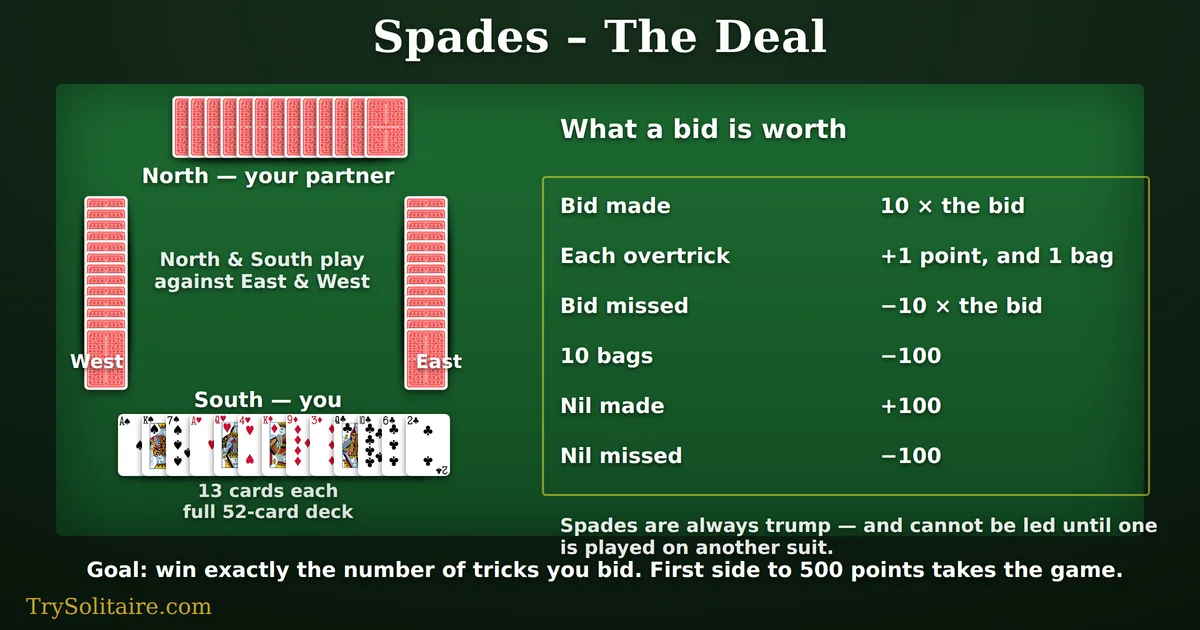
Spades uses a standard 52-card deck with no jokers. All four players receive thirteen cards, so the whole deck is dealt and nothing is left over. Partners sit opposite one another: North with South, East with West. You never see your partner's hand and you may not signal, so every message you send has to travel through the cards you choose to play.
Cards rank in the usual order within each suit, Ace high down to 2. Spades is the trump suit in every hand. Nobody bids for it and it never changes. That single fixed rule is what separates Spades from Bridge, Euchre and Belote, where naming the trump suit is half the contest.
Starting to the dealer's left, each player states the number of tricks they expect to win, anywhere from 0 to 13. You bid your own hand, not your partnership's. The two bids are then added together, and that sum is the contract your side has to make.
So if you bid 4 and your partner bids 3, your side needs seven tricks. It does not matter which of you wins them. Seven between you scores; six does not.
Count the tricks you can nearly always win, then add a little for shape:
Round down when the hand is flat and you hold no spades above the 10. An underbid costs you a bag; an overbid costs you the whole contract.
The player to the dealer's left leads the first trick. Play moves clockwise, one card each, and the four cards played form the trick.
You may not lead a spade until a spade has been played on a trick led with another suit. That first spade "breaks" them, and from then on anyone may lead one. The rule exists to stop the player holding the Ace and King of spades from simply pulling everyone's trumps on the first two tricks.
There is one exception, and it is the only time the rule bends: a player whose remaining cards are all spades has to lead one. Nothing else is legal.
Score each partnership after all thirteen tricks are played.
| Result | Score | Worked example |
|---|---|---|
| Contract made exactly | 10 × the bid | Bid 7, won 7 → 70 |
| Contract made with extras | 10 × the bid, +1 per overtrick | Bid 7, won 9 → 72 and 2 bags |
| Contract missed | −10 × the bid | Bid 7, won 6 → −70 |
| Tenth bag reached | −100, bags reset | 10 bags → −100 |
| Nil made | +100 | Bid 0, won 0 → +100 |
| Nil missed | −100 | Bid 0, won 1 → −100 |
The first side to 500 points wins. A side that drops to minus 200 loses on the spot. Notice how small the reward for a made contract is next to the penalties: a seven-trick contract earns 70, while ten accumulated bags cost 100.
A bag is a trick you win that you did not bid. It scores one point, which feels like a bonus. It is not. Bags carry forward from hand to hand, and the tenth one takes 100 points off your score.
Work the arithmetic. Ten bags earn you ten points along the way and then cost you a hundred, for a net loss of ninety, more than a made six-trick contract is worth. A side that quietly takes two spare tricks every hand hands back a full contract every five hands, and usually cannot say where the game went.
This changes how you play a hand that is already safe. Once your side has the tricks it bid, stop winning them. Play your low cards, duck when you can, and let the opponents take the rest. Deliberately losing a trick you could win is correct Spades, and it is the habit that separates a steady partner from a wild one.
Bidding Nil means promising to win no tricks at all. Make it and your side gains 100 points. Miss it by a single trick and your side loses 100. That 200-point swing is the largest single event in the game.
Your partner still bids normally and still has to make their own number, so a Nil is not a free ride. It commits one of you to taking nothing while the other carries the contract alone.
A hand suits Nil when it has no card that can be forced to win:
The danger is nearly always at the end of the hand. You survive nine tricks, then find your last two cards are the highest left. Count what is still out as you go, and shed dangerous cards early while the opponents still hold higher ones.
The Spades game here follows the rules on this page exactly: thirteen cards each, spades always trump, spades unable to be led until broken, ten points per trick bid, one bag per overtrick, a 100-point penalty at ten bags, Nil worth plus or minus 100, and a game to 500 or out at minus 200.
Three computer opponents fill the other seats, at easy, medium or hard. On hard they track your partner's bid against the tricks already won, count their sure winners before bidding, and play deliberately over or under a Nil bid depending on whose it is. There is no blind Nil in this version: every bid is made after you have seen your hand.
It runs in the browser with no download and no sign-up. You can install it as an app from your browser menu and play offline.
Four players in two partnerships each receive thirteen cards. Everyone bids the number of tricks they expect to win. Spades are always trump, and you must follow the led suit when you can. A side that makes its combined bid scores ten points per trick bid. The first side to 500 wins.
Not until spades are broken. A spade is played on a trick led with another suit, usually because someone is void. After that, anyone may lead a spade. The one exception is a player holding nothing but spades, who has no legal alternative.
A bag is a trick you win beyond your bid. Each one scores a single point at the time, so bags look harmless. They accumulate across hands, and every tenth bag costs your side 100 points. Ten bags wipe out ten made contracts.
The Nil fails and costs your side 100 points. The tricks you took still count toward your partner's part of the contract, so a failed Nil sometimes helps your partner make their bid. It is a partial consolation, not a rescue.
500 points. A game usually takes six to ten hands. A side that falls to minus 200 loses immediately, which is why repeated failed contracts end a game faster than most players expect.
Yes. If you hold a card in the suit that was led, you must play one. Only when you are void in the led suit may you play something else, including a spade. There is no requirement to beat the current winning card.
TrySolitaire has 301 card and puzzle games that run in your browser: Spades, Hearts, Euchre, Cribbage, Gin Rummy, Klondike, Spider, FreeCell, Sudoku, Mahjong and many more. No download and no sign-up. Install it as an app from your browser menu and it works offline.
Free • No sign-up • Works offline