Hearts inverts the thing every other trick-taking game rewards. In Euchre or Spades you fight for tricks. In Hearts a trick is a liability, because the penalty cards inside it land on your score. The whole game is the art of losing on purpose — right up to the one round where you try to win everything.
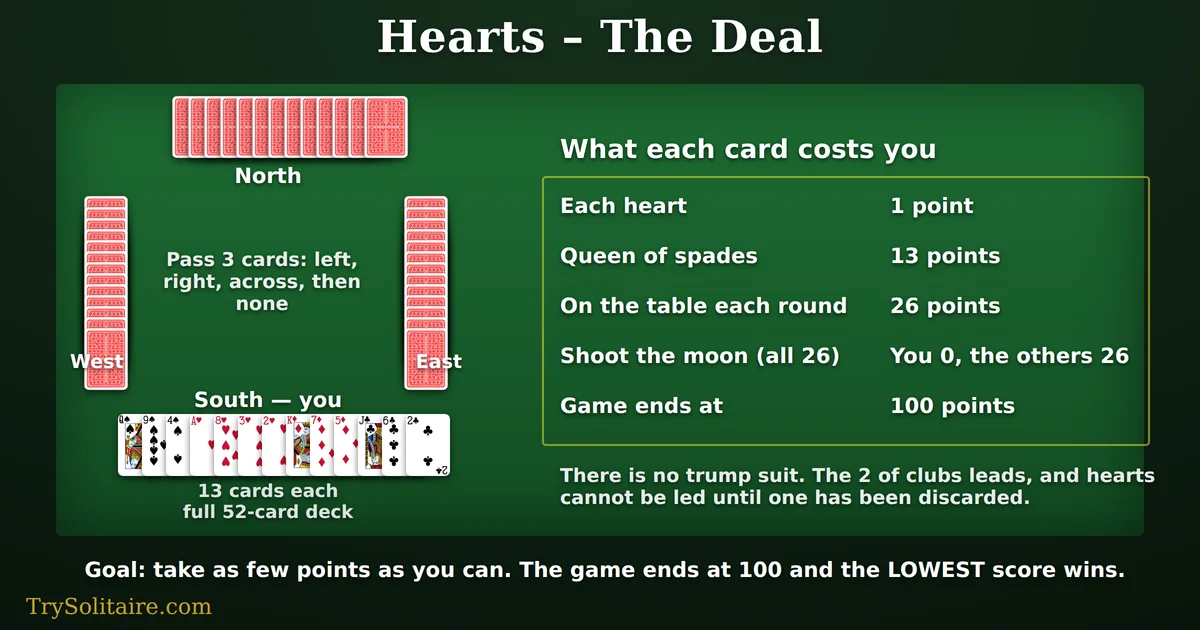
Four players, one standard 52-card deck, thirteen cards each. Nothing is held back and there is no kitty. Everyone plays for themselves — Hearts has no partnerships, which is what makes the table politics of it so different from Spades or Euchre.
There is also no trump suit. That single absence does more work than it looks. With no trump, the highest card of the suit that was led always wins the trick, so the danger in your hand is simply high cards in long suits. An Ace of diamonds is not power here. It is a card that will one day take a trick you did not want.
Before a card is played, every player picks three cards from their hand and passes them face down. You choose yours before you see the three coming back, so it is a simultaneous decision, not a reaction.
The direction rotates on a four-round cycle:
| Round | Pass direction |
|---|---|
| 1 | To the player on your left |
| 2 | To the player on your right |
| 3 | Across, to the player opposite |
| 4 | No pass — play the hand you were dealt |
Then it starts again at left. The hold round is the one where a bad deal stays bad, and it is worth watching for: you cannot shed the Queen of spades on anybody, and neither can they.
Most players treat the pass as a place to dump high cards. That is half of it. The other half is voiding a suit — passing away your last two diamonds so that later, when diamonds are led, you can throw a heart or the Queen on somebody else. A void is the only way to choose what you discard, and you build it here or not at all.
Whoever was dealt the 2 of clubs leads it. Not a club of their choosing — that exact card. It fixes the start of every round and removes the first-move advantage entirely.
The first trick is also protected: no heart and no Queen of spades may be played on it. Even a player who is void in clubs has to find something harmless. So the opening trick is always worth nothing, and it is the one trick in the game you can take without cost.
Play proceeds clockwise. You must follow the suit that was led if you hold a card in it. Only when you are void may you play anything at all — and that is precisely when the penalty cards come out.
The trap is that following suit is compulsory even when it hurts. If clubs are led and your only club is the King, the King goes down, and if someone behind you is void in clubs they will put the Queen of spades on it. Beginners lose rounds not by playing badly but by holding a high card in a suit they cannot get rid of.
The highest card of the led suit takes the trick, collects every penalty card in it, and leads the next one. A heart played by a void player does not win the trick; it just poisons it.
Hearts cannot be led until hearts have been broken, and they break the first time a player discards a heart on a trick of another suit — which they can only do when void. Until that moment, a player on lead must choose some other suit even if their hand is nothing but hearts.
Once broken, hearts may be led by anyone for the rest of the round. Note the asymmetry: the restriction is only on leading. You may discard a heart on someone else's trick from the very first opportunity you are void, and doing so is what breaks them.
| Card taken | Points |
|---|---|
| Each heart | 1 |
| Queen of spades | 13 |
| Total in play each round | 26 |
| Game ends when a player reaches | 100 |
Points are bad. When any player reaches 100 the game stops, and the lowest score wins — not the player who triggered the end, and not the highest.
Look at the Queen of spades again. Thirteen points is exactly half of everything in play, carried by one card. Taking all thirteen hearts costs the same as taking her once. That is why experienced tables spend the middle of a round quietly working out who still holds the Ace and King of spades, and why leading a low spade early — to draw her out of somebody's hand while you are safe — is such a common opening move.
If a single player takes all 26 points in one round — every heart and the Queen — the scoring flips. They score 0. Each of the other three scores 26.
It is rare, and it is the reason you cannot simply dump points on whoever looks weakest. A player who has already taken a few hearts and keeps taking them may not be losing; they may be halfway to a moon shot, and letting them have the last heart uncontested costs everyone else 26.
The defence is to take one point yourself. Just one heart, deliberately, breaks the attempt. Watching for a moon shot — and being willing to accept a small certain loss to stop a large one — is the piece of Hearts strategy that separates a casual player from a good one.
Our free online Hearts game handles the passing rotation, the 2 of clubs lead and the breaking rule for you, with three computer opponents. Nothing to download and no sign-up.
To take as few points as possible. Every heart you win in a trick is 1 point and the Queen of spades is 13, so there are 26 points to avoid each round. The game ends when someone reaches 100 points, and the player with the lowest score wins.
Whoever holds the 2 of clubs, and they must lead that exact card. It is not a choice. Nobody may play a heart or the Queen of spades on that first trick, so the opening trick is always safe.
Hearts are broken the first time someone discards a heart on a trick of another suit, because they were void in the suit that was led. Until that happens nobody may lead a heart. Afterwards anyone may lead one freely.
The direction rotates over four rounds: left, right, across, then a hold round with no pass. Everyone passes three cards at once, and you choose yours before you see what is coming to you.
Taking all 26 points in a single round — every heart and the Queen of spades. Instead of scoring 26 you score 0, and all three opponents take 26 each. It is the one time in the game that winning tricks is what you want.
Thirteen, which is exactly half the 26 points in play. One trick can cost more than an entire round of hearts, which is why so much of Hearts strategy is really about where that single card is.
Both, but the passing phase carries more skill than most newcomers expect. You choose three cards every round with full knowledge of your hand, and voiding a suit or shedding high spades there changes the whole round before a single card is played.
TrySolitaire has 300 card and puzzle games that run in your browser: Hearts, Spades, Euchre, Cribbage, Gin Rummy, Klondike, Spider, FreeCell, Sudoku, Mahjong and many more. No download and no sign-up. Install it as an app from your browser menu and it works offline.
Free • No sign-up • Works offline