Euchre is a fast partnership game played with only 24 cards. A hand takes about two minutes. The rule that catches every newcomer is the bowers: when a suit becomes trump, two Jacks jump above the Ace, and one of them changes suit entirely.
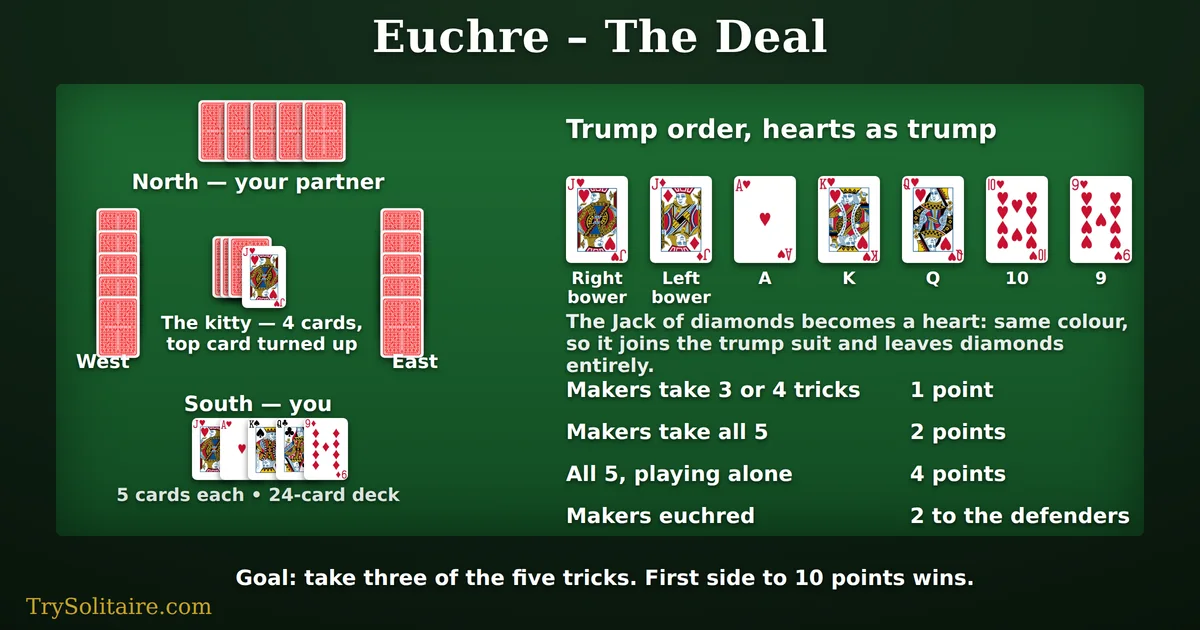
Euchre uses a stripped deck: the 9, 10, Jack, Queen, King and Ace of each suit, and nothing else. That is 24 cards. Four players sit in two partnerships, each player opposite their partner.
Every player gets five cards. The remaining four form the kitty, and the top card of the kitty is turned face up. That single upturned card drives the whole auction, because it is the suit on offer in the first round of bidding, and everyone can see it.
Once a suit is named as trump, the ranking inside that suit changes:
| Rank | Card, with hearts as trump | Name |
|---|---|---|
| 1 (highest) | Jack of hearts | Right bower |
| 2 | Jack of diamonds | Left bower |
| 3 | Ace of hearts | — |
| 4 | King of hearts | — |
| 5 | Queen of hearts | — |
| 6 | 10 of hearts | — |
| 7 (lowest) | 9 of hearts | — |
The left bower is the part people get wrong. The Jack of diamonds is no longer a diamond. If someone leads diamonds, you do not have to play it, and you cannot, unless you have no other diamond. It follows hearts instead, for the whole hand.
This also means the trump suit has seven cards while every other suit has five, and the suit of the same colour is down to four.
Bidding runs in two rounds, starting with the player to the dealer's left.
The turned card's suit is the only option. Saying "I order it up" makes that suit trump. The dealer then takes the turned card into their hand and discards one card face down. The player who ordered it up becomes the maker, and their side owes three tricks.
Note who benefits. If you order up and the dealer is your opponent, you have just handed them a guaranteed trump card. Ordering up from the dealer's left is a bid you should be able to justify.
If all four players pass, the turned card is set aside and a second round begins. Now each player may name any suit except the one that was turned down. Naming the suit of the same colour is called going "next", and it is often the strongest choice, because a turned-down suit being weak makes its colour-partner more likely to be strong.
In the version played here, the dealer cannot pass in the second round. If it reaches them, they must name a suit. This is called stick the dealer. It prevents hands being thrown in over and over, and it regularly forces the dealer into a contract they will be euchred on.
The player to the dealer's left leads first. After that, whoever wins a trick leads the next one.
Five tricks is not many. A single wasted trump usually decides the hand, which is why counting matters more here than in longer games.
| Result for the makers | Score | Who gets it |
|---|---|---|
| Three or four tricks | 1 point | The makers |
| All five (a march) | 2 points | The makers |
| All five, playing alone | 4 points | The makers |
| Two tricks or fewer — euchred | 2 points | The defenders |
The first side to 10 points wins. Look at the shape of that table: making your contract usually earns 1, but failing it hands the opponents 2. A marginal bid is a losing bid, and passing costs you nothing except the chance that the other side bids badly instead.
After naming trump, the maker may declare they are playing alone. Their partner puts their cards down and sits out the hand. Three players contest the five tricks.
The reward is 4 points for taking all five instead of 2, usually enough to decide the game. The risk is that you have given up five cards of help. Three or four tricks alone still scores only 1 point, exactly what you would have got with your partner.
The honest test: can you name the five tricks before you play? A hand with both bowers and the Ace of trump has three, and needs two more from a side Ace or a fourth trump. Anything less than that and you should keep your partner.
The Euchre game here follows the rules on this page: a 24-card deck, five cards each, a four-card kitty with the top card turned, both bowers, two bidding rounds with stick the dealer, going alone, and scoring of 1, 2 or 4 for the makers with 2 to the defenders on a euchre. The first side to 10 wins.
Three computer opponents fill the other seats at easy, medium or hard. It runs in the browser with no download and no sign-up, and you can install it as an app from your browser menu to play offline.
The right bower is the Jack of the trump suit and is the highest card in the deck. The left bower is the Jack of the other suit of the same colour. It becomes a trump for the whole hand and outranks the Ace of trump.
Twenty-four: the 9, 10, Jack, Queen, King and Ace of each suit. Everything from the 2 to the 8 is removed. Each player receives five cards and the four left over form the kitty.
Ordering up means accepting the turned card's suit as trump in the first bidding round. The dealer then picks that card into their hand and discards another. If you are the dealer's partner, you are giving the dealer a known trump card.
If all four players pass twice, the dealer is not allowed to pass again and must name a trump suit. It stops hands being thrown in repeatedly and forces a weak dealer into a contract they would rather avoid.
The side that named trump has to win at least three of the five tricks. Taking two or fewer means they are euchred, and the defending side scores 2 points. It is the reason a marginal hand is usually worth passing on.
Only with a hand that can take all five tricks by itself, which usually means both bowers and the Ace of trump. Going alone scores 4 points for a march instead of 2, but you lose your partner's cards, so three tricks still earns just 1.
TrySolitaire has 301 card and puzzle games that run in your browser: Euchre, Spades, Hearts, Cribbage, Gin Rummy, Klondike, Spider, FreeCell, Sudoku, Mahjong and many more. No download and no sign-up. Install it as an app from your browser menu and it works offline.
Free • No sign-up • Works offline