Canasta is rummy played with two decks and much bigger numbers. You collect cards of the same rank into melds, and a meld that reaches seven cards becomes a canasta worth up to 500 points. The rule that decides most rounds is not the melding. It is who gets to take the discard pile.
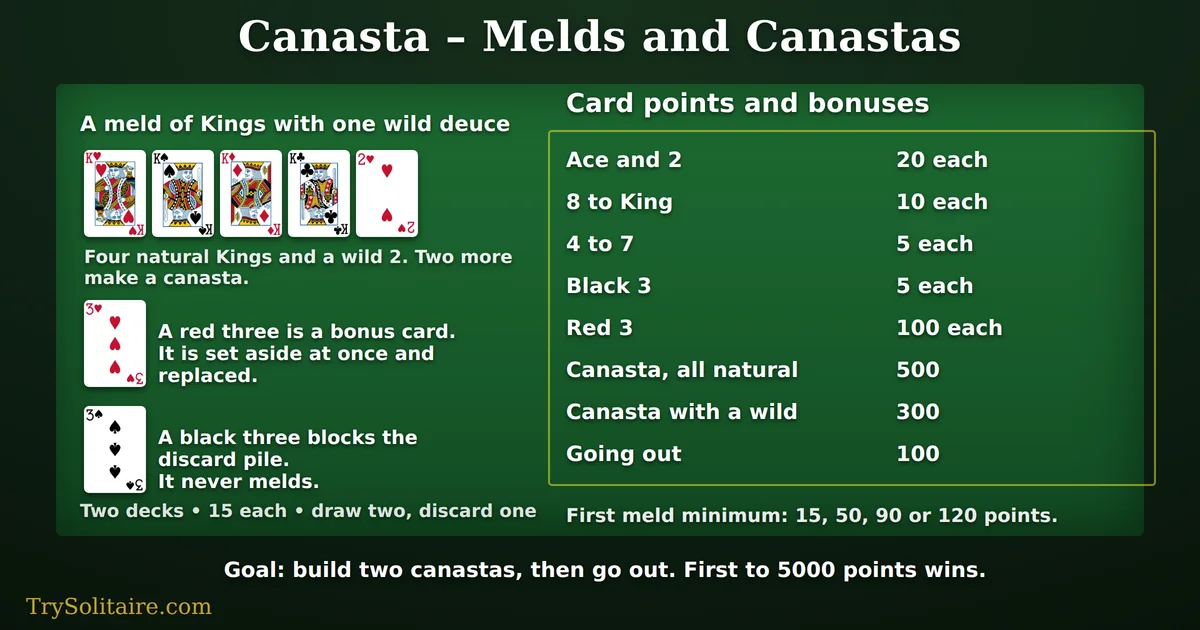
Canasta here is the two-player game, using two standard decks shuffled together: 104 cards. Each player gets fifteen. One card is turned face up to start the discard pile and the rest becomes the stock.
On your turn you draw two cards from the stock, or take the whole discard pile if the rules allow it, then discard one. Drawing two is the two-player rule; it makes hands move fast.
Threes are not ordinary cards:
| Card | Points |
|---|---|
| Ace and 2 (wild) | 20 each |
| 8, 9, 10, Jack, Queen, King | 10 each |
| 4, 5, 6, 7 | 5 each |
| Black 3 | 5 each |
| Red 3 | 100 each, as a bonus |
These values do double duty. They count toward your score when melded, and against you when the round ends with the cards still in your hand. Holding two aces at the end costs you forty.
A meld is three or more cards of the same rank, laid face up in front of you. Suits are ignored entirely. Three Kings of any suits is a valid meld.
Deuces are wild and can stand in for any rank, with two limits that matter:
So four Kings and three deuces is legal. Two Kings and four deuces is not.
A wild card completes a meld now, but it costs you 200 points at the end: a natural canasta scores 500 and a mixed one scores 300. Save your deuces for a meld you cannot finish naturally, or for the moment you need to take a frozen pile.
You cannot start melding with anything you like. Your first meld of a round has to reach a minimum point total, and that minimum rises as you win:
| Your cumulative score | First meld must total |
|---|---|
| Below zero | 15 points |
| 0 to 1499 | 50 points |
| 1500 to 2999 | 90 points |
| 3000 and above | 120 points |
You may spread the requirement across several melds as long as you put them all down in the same turn. Bonuses do not count toward it: only the card values in the melds themselves. This is what makes the leader's life harder as a game goes on.
The discard pile is taken whole, not one card at a time. Late in a round it can be twenty cards, which is why the rules protect it.
Whether you may take it depends on one thing: is the pile frozen?
Freezing the pile is a real weapon. If your opponent has melds on the table and you do not, discarding a deuce locks the pile away from them until they hold a natural pair.
A meld that reaches seven cards is a canasta:
You may keep adding cards to a canasta after it is complete. To go out you must play your last card and hold two canastas. Going out scores an extra 100.
Each round scores your melded card points, plus red threes, canastas and the going-out bonus, minus every card still in your hand. First to 5000 points wins.
The Canasta game here is the two-player game described on this page: two decks with deuces wild and no jokers, fifteen cards each, draw two and discard one, red threes worth 100 and replaced automatically, black threes that block the pile, melds of at least two natural cards and at most three wilds, the 15/50/90/120 initial meld ladder, frozen-pile rules, canastas at 500 natural and 300 mixed, two canastas required to go out for 100, and a game to 5000.
Jokers are not used in this version, so every wild card is a deuce. You play against the computer at easy, medium or hard. It runs in the browser with no download and no sign-up, and you can install it as an app from your browser menu to play offline.
A canasta is a meld of seven or more cards of the same rank. One made entirely of natural cards scores 500 points. One containing at least one wild card scores 300. You need two canastas before you are allowed to go out.
One hundred points each. A red three is a bonus card, not a playing card: you set it face up as soon as you get it and draw a replacement. It never melds and never counts against you as a card left in hand.
The pile is frozen once a wild card has been discarded onto it. While frozen, you can only take it by matching the top card with two natural cards from your own hand. An existing meld of that rank is not enough.
It is measured in points, not cards. Your first meld of a round must total at least 15, 50, 90 or 120 points as your cumulative score climbs. The cards can be spread across several melds as long as they are laid down together.
A black three discarded onto the pile blocks your opponent from taking it on their next turn. Black threes cannot be melded during normal play and are worth five points each. They are the cheapest defensive card in the game.
5000 points, played across several rounds. Each round scores your melded card points plus bonuses, minus the value of the cards still in your hand. A single natural canasta plus going out is worth 600 before the cards are counted.
TrySolitaire has 301 card and puzzle games that run in your browser: Canasta, Gin Rummy, Rummy 500, Cribbage, Spades, Euchre, Klondike, Spider, FreeCell, Sudoku, Mahjong and many more. No download and no sign-up. Install it as an app from your browser menu and it works offline.
Free • No sign-up • Works offline