TriPeaks Solitaire — Free Online, 3 Peaks, ±1 Rank Matching
TriPeaks is a fast, sequence-driven solitaire built around three overlapping pyramids and a single 52-card deck. You clear pyramid cards by matching them one rank above or below the top of the waste — suits don't matter, and the rank order wraps so Kings connect to Aces. We measured 97% of deals as solvable with perfect play, well above Klondike's ~82%, which is why TriPeaks feels generous while still rewarding planning. Free in your browser, no sign-up.
Quick Start: Play in 30 Seconds
- Goal: Clear all 28 pyramid cards by matching them ±1 rank from the top of the waste pile.
- Tap any uncovered pyramid card whose rank is one above or below the waste. Suits are ignored.
- Ace–King wraps: King plays on Ace, Ace plays on King, in either direction.
- Out of plays? Click the stock to flip the next card to the waste. No recycle — once the stock empties, it's empty for good.
- Build long streaks. Each consecutive card scores 50 × your current streak. A 10-card run is worth 2,750 points.
Click Play TriPeaks and you're playing. Drag or tap to move cards. Unlimited undo means you can experiment without losing your streak.
The Three Peaks Layout
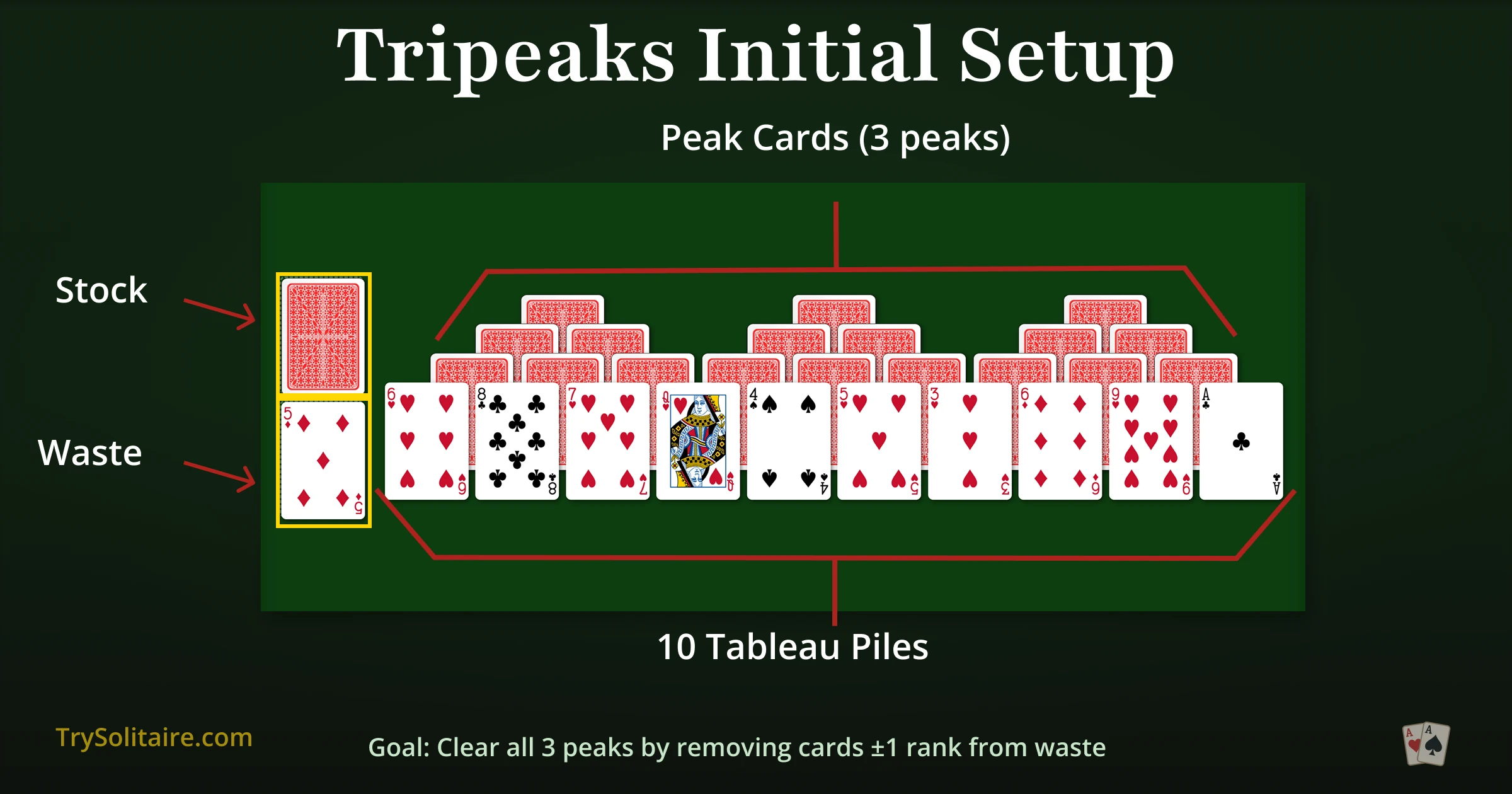
Despite the visual overlap, the three pyramids share no cards — they overlap only on screen. Each pyramid has 1 peak, 2 middle-row cards, and 3 base-row cards, for 18 cards total. A 10-card bottom row sits across all three pyramids and is face-up from the start.
| Row | Cards | Starts face-up? |
|---|---|---|
| Bottom (base of all three pyramids) | 10 | Yes — playable immediately |
| Base rows of each pyramid (3 per pyramid) | 9 | Covered until the row below clears |
| Middle rows of each pyramid (2 per pyramid) | 6 | Covered by base rows |
| Peaks (top of each pyramid) | 3 | Covered until the middle row clears |
| Stock (face-down draw pile) | 23 | Click to flip to waste |
| Waste (the active matching card) | Starts with 1 | Always face-up |
A pyramid card is in play only when no card overlaps it. The bottom row covers each pyramid's base; the base covers the middle row; the middle row covers the peak. Clearing a peak feels good for a reason: you've worked through three layers to get there.
Streak Scoring: Why One Long Run Beats Five Short Ones
TriPeaks rewards consecutive plays far more than individual cards. Most of your final score comes from one or two long streaks, not many short runs.
| Event | Points |
|---|---|
| Pyramid card cleared | 50 × current streak multiplier |
| Streak multiplier | Starts at 1, +1 per consecutive card, resets to 1 on stock draw |
| Peak cleared (×3 peaks) | +100 each |
| Game won | +1,000 |
| Card left in stock | −25 each |
A 10-card streak alone scores 50 + 100 + 150 + 200 + 250 + 300 + 350 + 400 + 450 + 500 = 2,750 points. Spread the same ten cards across five short streaks and you get 5 × (50 + 100) = 750 points — less than a third. Streak management is the central skill.
What's the Best TriPeaks Strategy?
Five tactical points. All five are scoring-driven: streak multiplier compounds, and one long sequence outscores three medium ones by a wide margin.
Always extend before you draw
Every stock draw resets your streak. Before clicking the stock, scan every uncovered pyramid card to confirm none is one rank away from the current waste. A missed match is a thrown-away multiplier.
Prefer plays that uncover the most new cards
When two cards are both legal, play the one that exposes more cards underneath. A middle-row card usually uncovers two cards below it; a base-row card uncovers fewer; the bottom row uncovers nothing.
Look ahead before committing to a direction
When you can play either a 6 or an 8 on the current 7, the better choice is whichever continues longer. Five seconds of scanning beats five seconds of regret.
Work the three peaks evenly
Clearing one peak entirely while ignoring the others usually leaves you stuck — the remaining cards cluster in the same rank range and starve your sequences. Spread your plays across all three pyramids.
Mind the edge ranks
Aces and Kings only have two ranks they match (2 or Queen for King; King or 2 for Ace). When you draw an edge rank from stock, check whether the necessary continuation cards are still in play before committing.
How Often Can You Win?
TriPeaks has no peer-reviewed solvability study like Yan, Diaconis, Rusmevichientong and Van Roy (2005) for Klondike, so the exact theoretical figure is unknown. Reasonable estimates from large-scale digital play data:
- Measured solvability: 97.0% of deals — 9,704 of 10,000 random deals cleared by an exhaustive solver.
- Skilled players: 70–85% practical win rate.
- Average players: 40–60%.
The high solvability is structural: only 28 pyramid cards need to be cleared, the rank wrap means edge ranks aren't dead-ends, and a 23-card stock provides plenty of recovery material. Pyramid Solitaire uses the same 28 cards and is harder on the same measure: 67.5% solvable against 97.0% here, both measured with the same solver and the rules this site ships. The gap would be far wider under Pyramid's classic one-pass rule, where the figure drops to about 5% — TriPeaks's play to ±1 is more forgiving than Pyramid's pair to 13 either way.
TriPeaks vs Pyramid Solitaire
The two games share a pyramid-shape layout and the number 28, and that's where the similarity ends.
| Aspect | TriPeaks | Pyramid |
|---|---|---|
| Pyramid count | Three overlapping pyramids | One pyramid |
| Matching rule | ±1 rank from waste | Pair of cards summing to 13 |
| Suit relevance | Suits ignored | Suits ignored |
| Stock cycles | One pass, no recycle | Unlimited recycles in this version |
| Measured solvability | 97.0% | 67.5% |
| Skilled win rate | 70–85% | 10–20% |
| Scoring | Streak multiplier rewards long runs | Flat per-card |
If you want a session that feels generous and rewards planning long streaks, play TriPeaks. If you want a session that feels earned and where most attempts fail, play Pyramid.
Why Play TriPeaks Here
- Native streak scoring. The multiplier is visible above the play area so you can see what you're risking on every draw.
- Unlimited undo. Reverse moves without losing your streak — useful when you spot a longer path after committing to a shorter one.
- Daily challenge. Same deal for everyone that day — compare scores with other players.
- Install as an app. Add it to your phone or computer's home screen. After install, it works without internet.
- Free, no sign-up, no download. Stats save locally; nothing leaves your device unless you install.
Related Pyramid-Style Solitaire
TriPeaks sits alongside a small family of solitaire games built on a pyramid layout. The siblings worth knowing:
- Pyramid Solitaire — single pyramid, pair cards summing to 13, Kings clear alone. Much harder than TriPeaks (most deals unwinnable) but the win feels earned.
- Golf Solitaire — TriPeaks's closest cousin. Same ±1 rank matching, but a 7×5 tableau instead of three pyramids, and no Ace–King wrap.
- Klondike — the seven-column classic. Build the foundations Ace to King by suit, with alternating-color tableau sequences in between.
- FreeCell — every card face-up, four "free cells" instead of a stock. Almost every deal is winnable.
Frequently Asked Questions
Is TriPeaks Solitaire free to play?
Yes. TriPeaks on TrySolitaire is free, with no download or sign-up. The game runs in your browser and can be installed as an app on any device, after which it works without an internet connection.
Do suits matter in TriPeaks?
No. Only rank matters. Any 6 plays on any 5 or any 7. Suits are purely cosmetic. The simplification is what lets sequences run as fast as they do — you only have to scan rank, not suit-and-rank.
Can a King play on an Ace?
Yes. TriPeaks treats the rank order as a loop: King–Ace–2 is legal in either direction. So King plays on Ace, and Ace plays on King. Without the wrap rule, edge ranks would dead-end too often and long streaks would be rare.
How does the streak multiplier work?
Each card you play scores 50 points × your current streak. The streak starts at 1 and increases by 1 with every consecutive pyramid card you clear. Drawing from stock resets it to 1. A 10-card streak therefore scores 50+100+150+...+500 = 2,750 points — far more than ten separate plays would.
What percentage of TriPeaks games are winnable?
We measured it: 97.0% of deals are solvable. An exhaustive solver mirroring this version's rules cleared 9,704 of 10,000 random deals, with none left undecided. That is a ceiling for perfect play with full lookahead, not a win rate — skilled players land around 70–85% in practice. The figure is well above Klondike's ~82% solvability (Yan et al., 2005), and above the ~90% TriPeaks is usually cited at, which comes from play data rather than a solver.
Where does TriPeaks come from?
TriPeaks is credited to Robert Hogue, who designed it in the late 1980s. It first reached a wide audience in Microsoft Entertainment Pack 3 (1991), then returned to mainstream Windows in the Microsoft Solitaire Collection that ships with Windows 8 and later.
Ready to Play?
Free, in your browser, no sign-up. Three pyramids, one long streak, and the multiplier doing the work.
Play TriPeaks Free