Pyramid Solitaire — Free Online, Pair to 13
Pyramid Solitaire is a single-deck patience built around a 28-card pyramid and a simple arithmetic rule: pairs of cards that add to 13 come off together. Aces count as 1, Jacks as 11, Queens as 12, and Kings as 13 — Kings clear alone. Most deals are unwinnable, which is the source of the game's reputation: a Pyramid win feels earned. Three stock recycles, unlimited undo, free in your browser, no sign-up.
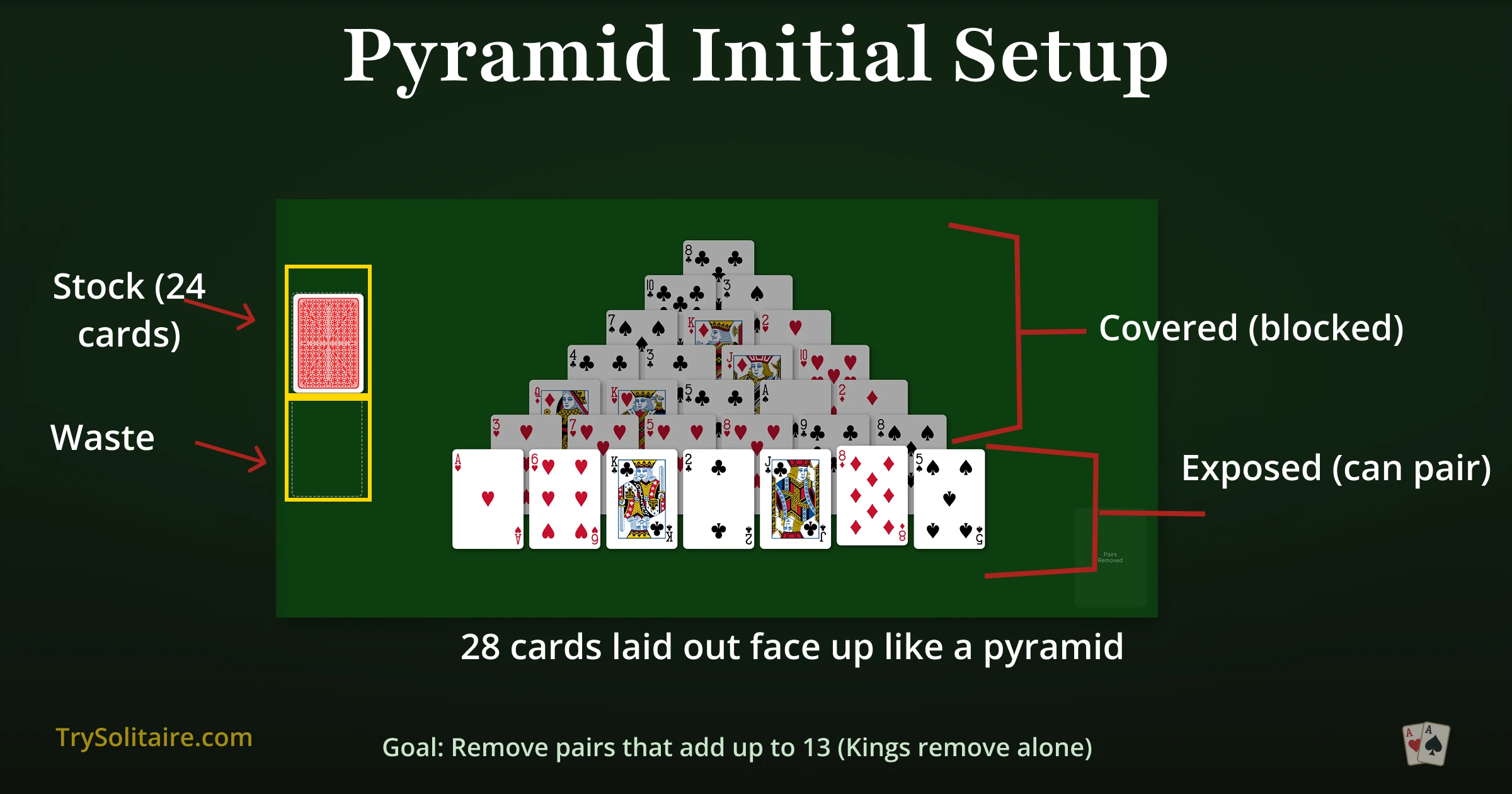
Quick Start: Play in 30 Seconds
- Goal: Remove all 28 pyramid cards (and ideally the stock too) by pairing cards whose ranks add to 13.
- Click two uncovered cards whose ranks sum to 13. They both clear. Suits don't matter.
- Kings clear alone — a single click removes any uncovered King.
- Out of pairs? Click the stock to flip the next card to the waste. You get three passes through the stock.
- Use the top of the waste as one half of a pair when you can — saving the right card for the right pyramid match is the whole game.
Click Play Pyramid and you're playing. Unlimited undo means you can experiment with pair order without restarting.
The 13-Pairs at a Glance
There are six valid pairs plus one free out. Memorising them turns most of the game into pattern recognition.
| Pair | Card combination |
|---|---|
| 1 + 12 | Ace + Queen |
| 2 + 11 | 2 + Jack |
| 3 + 10 | 3 + 10 |
| 4 + 9 | 4 + 9 |
| 5 + 8 | 5 + 8 |
| 6 + 7 | 6 + 7 |
| 13 | King (alone) |
Aces and 2s only pair with high cards (Queen and Jack). 5s, 6s, 7s, and 8s pair with each other in the middle. Kings are free.
The Rules in Full
- Pyramid coverage. A pyramid card is in play only when no card overlaps it. Each card is covered by the two cards in the row below — so the entire bottom row (7 cards) is uncovered at the start, and the peak card sits seven layers deep.
- Valid pairs. Two uncovered pyramid cards summing to 13, or one uncovered pyramid card paired with the top of the waste. Suits are ignored.
- Kings. A King uncovered anywhere — pyramid, waste, or stock when it flips — removes itself in a single click.
- Stock and waste. Click the stock to flip the next card to the waste. Only the top of the waste is in play.
- Recycle. When the stock empties, click it again to flip the waste back over as a fresh stock. Our version allows three passes total. After that, you play with what's on the table.
- Win condition. All 28 pyramid cards cleared. Bonus if you also clear the stock and waste — most published rulesets count this as a full victory.
- Loss condition. No legal pair available with the stock cycles exhausted.
What's the Best Pyramid Strategy?
Five tactical points. Pyramid is the rare patience where counting cards is most of the skill — every choice you make about which pair to play affects whether the other copies of those ranks are reachable later.
Clear Kings as soon as you see them
Kings remove themselves, free up two cards underneath, and never lock you out. There's no strategic reason to delay them.
Work the pyramid before the stock
Every stock draw burns a card you may need later. Exhaust the pairs you can see in the pyramid before flipping. The bottom row is fully exposed from move one — there's almost always something to do there before touching the stock.
Watch for blocked pairs
If both 6s in the bottom row sit directly under the same 7, you can never reach that 7 — every pair-of-6 destroys the route. Spot these dead-ends early so you can route around them before they trap you.
Track which copies remain
Each rank has four copies. After a 6+7 pair, three of each remain. When a rank's last copy is buried under a chain you can't reach, the cards needing that rank are stuck. Pyramid is a counting game disguised as a clicking game. Spread your pairs across the pyramid rather than clearing one side first — uneven removal leaves the other half blocked by ranks you've already burned.
Save useful waste cards for harder matches
If the current waste card is a 6 and you can see two 7s in the pyramid — one easy to reach, one buried — don't immediately pair the 6 with the easy match. The buried 7 may need it more.
How Often Can You Win?
Pyramid is one of the harder patience games in the canon. Even with perfect play, the published numbers are sobering.
- Measured solvability: 67.5% of deals — 6,749 of 10,000 random deals cleared by an exhaustive solver, none undecided. The 0.5% to 2.5% usually published is for a single pass through the stock; this version recycles without limit, and the same solver clears about 5% under the one-pass rule.
- Skilled players: ~10–20% practical win rate. The gap below the solver figure is the cost of playing without full lookahead — pattern recognition and bottom-row counting close part of it, never all of it.
- Average players: 3–8%.
The unwinnability comes from the pyramid's geometry. With only 28 cards arranged so the peak sits seven layers deep, blocked-rank chains form early and propagate. Compare with TriPeaks (same 28 pyramid cards but the ±1 rule and Ace–King wrap) where typical solvability is around 90% — the matching rule is what makes the difference, not the layout.
Why Play Pyramid Here
- Three stock recycles. The more forgiving ruleset that gives skilled play a real chance to convert. Single-pass Pyramid is the masochistic version; three-pass is the version most players actually enjoy.
- Unlimited undo. Reverse moves without penalty — useful for pyramid-counting practice and for backing out of a sequence that turns out to lock the next card.
- Daily challenge. Same deal for everyone that day — compare clear rates and remaining-card counts.
- Install as an app. Add it to your phone or computer's home screen. After install, it works without internet.
- Free, no sign-up, no download. Stats save locally; nothing leaves your device unless you install.
Related Pyramid-Style Solitaire
Pyramid sits in a small family of solitaire games built on a pyramid layout — and a larger family of patience games with a single 28-card pyramid. Worth knowing:
- TriPeaks Solitaire — same 28-card pyramid count but three peaks instead of one, ±1 rank matching instead of pair-to-13, and ~90% winnability instead of ~2%. The friendlier cousin.
- Golf Solitaire — 7×5 tableau (also 35 cards), ±1 rank matching with no wrap. Similar matching feel, very different layout.
- Klondike Solitaire — the classic seven-column game. Build foundations Ace to King by suit, with alternating-color tableau sequences in between.
- FreeCell — every card face-up, four "free cells" instead of a stock. Almost every deal is winnable. Worth playing if Pyramid's unwinnability gets to you.
Frequently Asked Questions
Is Pyramid Solitaire free to play?
Yes. Pyramid on TrySolitaire is free, with no download or sign-up. The game runs in your browser and can be installed as an app on any device, after which it works without an internet connection.
Are all Pyramid Solitaire games winnable?
No, but far more than Pyramid's reputation suggests. The published 0.5% to 2.5% figures describe a single pass through the stock. This version recycles the stock without limit, which is a different game: an exhaustive solver cleared 6,749 of 10,000 random deals — 67.5% — with none left undecided. The same solver clears about 5% under a one-pass rule. Solvable is not won: the solver searches every branch before moving, so expect to clear far fewer by eye.
Why are Kings removed alone?
Because a King is worth 13 by itself, so it already meets the pair-to-13 rule with no partner needed. Mechanically this means Kings are free outs — they always come off when uncovered. There's no strategic reason to delay them.
Can I pair two cards from the waste?
No. Only the top card of the waste is in play. You can pair the top of the waste with any uncovered pyramid card, or pair two uncovered pyramid cards together. Two waste cards never pair directly because only one is exposed at a time.
How many times can I cycle the stock?
Three times in our version. The standard published ruleset varies between one pass and three passes; three is more forgiving and is the version found in most modern digital implementations. After the third cycle ends, you play with what's already on the table.
Where does Pyramid Solitaire come from?
Pyramid is one of the older patience games — it appears in Lady Adelaide Cadogan's Illustrated Games of Patience (1870s) under the name Pile of Twenty-Eight. The modern audience came from Microsoft Entertainment Pack 4 in 1992 and the Microsoft Solitaire Collection that ships with Windows 8 and later.
Ready to Play?
Free, in your browser, no sign-up. Three stock cycles, unlimited undo, and the satisfaction of a clear that almost wasn't there.
Play Pyramid Free