Play Mahjong Connect — Match Tiles Joined by a Path
Mahjong Connect is a tile-matching puzzle played on a flat grid. Pick two tiles that show the same face. If a clear path joins them, both tiles vanish. Clear the whole grid to win. The game is known in Chinese as 连连看 (lianliankan, "link link see"), and in Japan and Korea as Shisen-Sho and Sacheonseong. Free in your browser, no download.
Mahjong Connect rules
- Match pairs. Click two tiles with the same face to clear them.
- Two turns. The path between them may bend twice at most — three straight lines.
- Clear path. The path runs only through empty cells. It never crosses another tile.
- The path may leave the board. The empty margin around the grid is open space.
- Clear the board to win. If no pair can connect, the board reshuffles itself for free.
The Two-Turn Rule
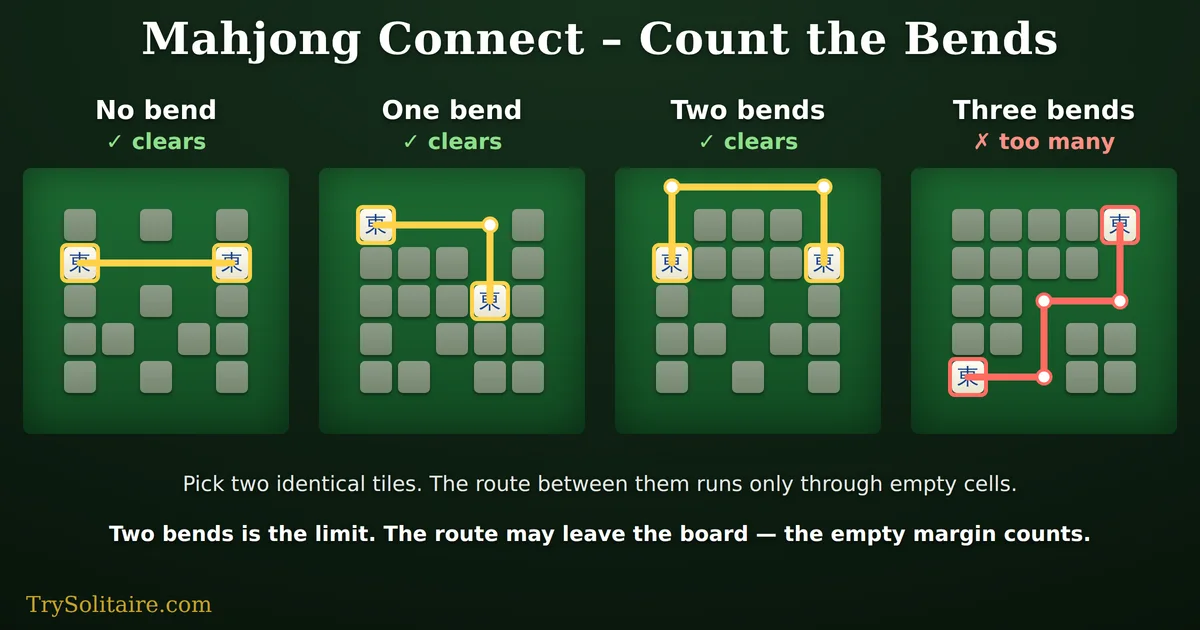
This is the whole game, and it is the one rule worth learning properly. Two tiles connect when a path joins them that:
- travels only through empty cells — never through another tile;
- runs in straight horizontal or vertical lines; and
- turns a corner at most twice.
A straight line between two tiles is zero turns. An L-shape is one turn. A Z-shape or a U-shape is two. Three turns is not a match, however clear the route looks.
The path may leave the grid. There is a one-cell margin all the way round the board, and it is always empty, so two tiles on opposite edges can join by going out, along, and back in. That is why a tile on the far left can often take a tile on the far right even when the row between them is full.
When you make a match the route flashes on the board for a moment. Watch it — after a dozen matches you will start seeing the two-turn routes before you click.
How Mahjong Connect Differs From Mahjong Solitaire
They use the same tiles and they are not the same game. Mahjong Solitaire stacks tiles in layers and asks which tiles are free: uncovered, with an open left or right side. Height is the obstacle.
Mahjong Connect lays every tile flat in a single layer. Nothing is ever covered, so every tile is always visible and always selectable. The obstacle is not height but distance — whether a route exists inside the turn budget. Solitaire is a game about digging down. Connect is a game about seeing across.
Mahjong Connect Classic
This is the classic game. "Classic" separates the original from everything later built on top of it, and it means three things.
- Traditional tile faces. The real Mahjong suits, Winds, Dragons, Flowers and Seasons — not fruit, animals or sweets.
- A still board. A cleared pair leaves a gap, and nothing moves into it. Later variants slide the survivors toward one edge after every match, which rewrites every route you had planned.
- The two-turn rule, unmodified. Three straight lines, two bends. No countdown, no power-ups, no extra turn bought with a coin.
A still board is what makes this a puzzle you can read. Nothing moves, so a route you can see now is still there in ten seconds. You can plan two or three matches ahead instead of re-reading the grid after every click.
No Dead Ends
A Mahjong Solitaire board can deal itself into a position with no legal move left, and the player has to spend a shuffle to dig out. Mahjong Connect does not work that way here. When no pair on the board can still be joined, the board reshuffles itself — free, automatically, and as often as it needs to. Every game can be finished.
Reshuffles are counted, though. Clear a board without one and you earn a clean-sweep bonus worth more than most of the matches that got you there.
Strategy
Work the edges first
Tiles on the outer ring border the margin, so they can almost always reach each other. Tiles buried in the middle of a full grid usually cannot. Clearing the edge early does not just remove tiles — it opens the lanes that everything inside will later need.
Open lanes, not just pairs
Two matches are rarely equal. A pair that removes two tiles from the middle of a packed row cuts a channel through the board. A pair that takes two tiles already sitting in open space changes nothing. When you can see both, take the one that opens the lane.
Count your copies
Most faces appear more than twice. If three copies of a tile are on the board and two of them are easy, think before taking the easy pair — you may be leaving the last copy stranded behind a wall with nothing to match.
Chain your matches
Matches made in quick succession build a combo multiplier, and a longer route scores more than a short one. Once a section starts falling, keep going while the board is open rather than pausing to scan elsewhere.
Use the hint sparingly
The hint finds a legal pair and draws its route, which is the fastest way to learn what two turns actually looks like. It costs a few points, so treat it as a teacher rather than a crutch.
Board Sizes
Three grids, all using the traditional Mahjong tile faces:
- Easy — 10 x 6, 60 tiles. Short games with plenty of open space; a good place to learn the turn rule.
- Medium — 12 x 8, 96 tiles. The standard board.
- Hard — 16 x 9, 144 tiles. The same tile count as a full Mahjong set, packed tight enough that the middle is genuinely hard to reach.
Larger is not simply harder: a big board has more copies of each face, so more pairs are available at any moment. What makes Hard demanding is that the centre stays walled in far longer.
Tiles
Connect uses the same faces as the traditional set — the three suits (Bamboo, Characters, Dots) numbered one to nine, the four Winds, the three Dragons, and the Flowers and Seasons. Unlike Mahjong Solitaire, every face here matches only its exact twin: one Flower does not take another Flower. If you are new to the tiles, the Mahjong tiles guide explains what each one means.