Play Mahjong Solitaire — 144 Tiles, Match Free Pairs, Clear the Layout
Mahjong Solitaire is a single-player tile-matching puzzle that uses the 144 tiles from a traditional Chinese Mahjong set. Match pairs of identical free tiles to remove them. Clear every tile to win. The game is also called Shanghai Solitaire after the 1986 Activision port that introduced it to a wide computer audience. Free in your browser, 650+ layouts, no sign-up. Works offline once the page has loaded.
How Do You Play Mahjong Solitaire?
Goal: remove all 144 tiles by matching identical free pairs.
Setup
- 144 tiles from the standard Chinese Mahjong set.
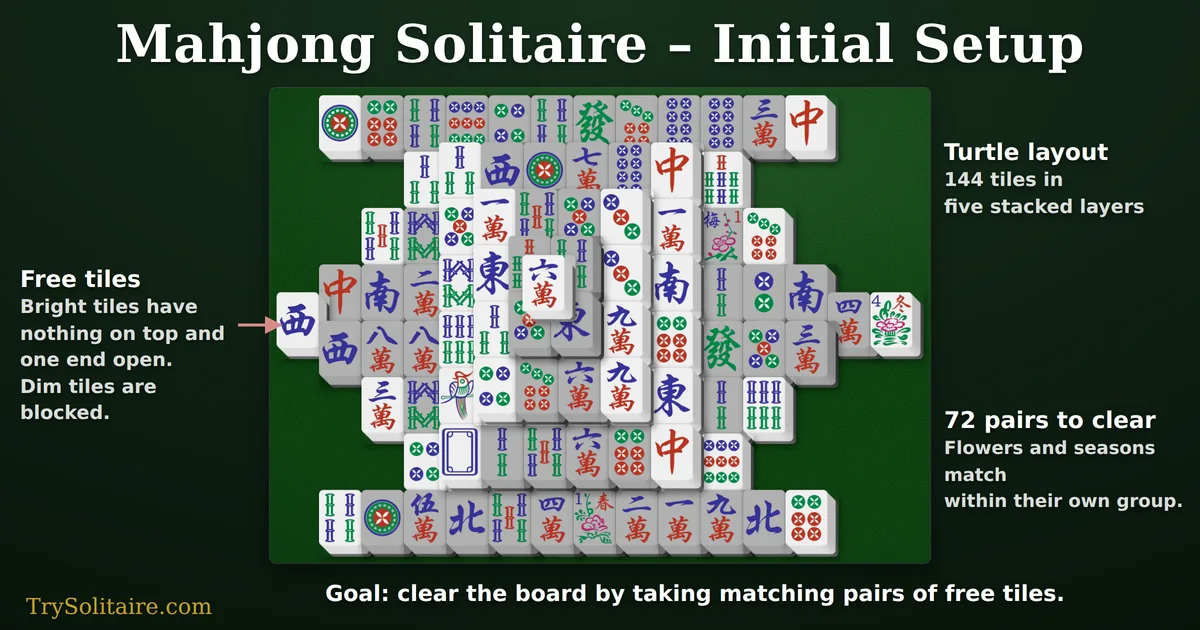
- Stacked layout — tiles arranged in 3D layers, typically the Turtle shape.
- Tile categories: Dots, Bamboos, Characters, Winds, Dragons, Seasons, Flowers.
- All tiles visible from the start — no hidden information.
Rules
- Free tile. A tile is free when no tile sits on top of it AND at least one side (left or right) is open.
- Matching. Click two identical free tiles to remove them.
- Wildcards. Any Season matches any other Season. Any Flower matches any other Flower.
 =
=
 =
=
 =
=

- No replacement. Removed tiles stay removed.
- No time limit. Take your time.
Tile categories




















Six Strategies That Actually Work
1. Clear top tiles and edges first
- Top-layer tiles should go first when you can. Removing them frees the tiles underneath.
- Clear edge tiles to open more sides on adjacent tiles.
- Prefer tiles that block many others over tiles that block none.
2. Avoid creating locked pairs
- Don't match a pair if doing so exposes the only other identical pair underneath.
- That's how four copies of a tile end up locked — two visible up top, two trapped below with no way to reach them.
- Example: removing two 5-Bamboos that expose two more 5-Bamboos beneath.
- Always check what your match will reveal before clicking.
3. Save Seasons and Flowers
- Seasons and Flowers are wild within their group. Any Season pairs with any Season; any Flower with any Flower.
- They never lock — there are only four of each, and any two free tiles in the group match.
- Save them for moments when you need to clear a blocker.
4. Track tile counts
- Each regular tile has exactly four copies. After matching one pair, two remain.
- Note where the remaining copies sit before committing to a match.
- If both remaining copies are deep in the same stack, you may not be able to reach them.
5. Work from outside to inside
- Outer tiles have more free sides, so they unlock faster.
- Removing the outer ring exposes the inner cluster.
- This pattern reduces the chance of trapping tiles in unreachable positions.
6. Use Hint sparingly
- Hint shows a legal pair when you're stuck. Use it after you've tried to find one yourself.
- Pattern recognition is the main skill in Mahjong Solitaire. Hints short-circuit the practice.
How Scoring Works
This Mahjong uses a dynamic scoring system that rewards strategic tile selection and consistent play.
Base points
Each match earns points based on two factors: the tile type value and the number of tiles remaining on the board:
Base Points = Tile Value × Tiles Remaining
Early matches (when more tiles remain) score more, rewarding aggressive play from the start.
Tile values
- Characters: 2 points per tile remaining
- Dots: 4 points per tile remaining
- Bamboos: 6 points per tile remaining
- Winds: 8 points per tile remaining
- Dragons: 10 points per tile remaining
- Flowers: 12 points per tile remaining
- Seasons: 14 points per tile remaining (highest)
Chain multiplier
Match tiles of the same suit consecutively to build a chain multiplier:
- 1st match. ×1 (base points).
- 2nd consecutive same-suit match. ×1.5.
- 3rd consecutive. ×2.
- 4th consecutive. ×2.5.
- The multiplier grows by ×0.5 for each additional consecutive same-suit match.
The chain resets when you match a different suit. Look for opportunities to chain several pairs of the same suit for big bonuses.
Scoring tips
- Match high-value tiles (Seasons, Flowers, Dragons) early while many tiles still remain.
- A Season match at the start (144 tiles) earns 14 × 144 = 2,016 base points.
- Build chains by matching the same suit consecutively for the multiplier.
- Balance scoring against board management — don't get stuck chasing points.
Mahjong Solitaire vs Traditional Mahjong
The two share tile art and almost nothing else.
| Aspect | Mahjong Solitaire | Traditional Mahjong |
|---|---|---|
| Players | 1 | 4 |
| Goal | Match free pairs to clear the board | Build winning hands of melds |
| Created | 1981 (digital) | 19th-century China |
| Skill type | Spatial puzzle, pattern recognition | Strategy, memory, social play |
Mahjong Solitaire was designed in 1981 by Brodie Lockard on the PLATO computer system at the University of Illinois, where he called it Mah-Jongg. Activision licensed and renamed it Shanghai for personal computers in 1986, which is the version most older players remember.
Is Every Mahjong Layout Winnable?
No. Random shuffles can produce unwinnable boards — a position where every remaining match locks the next one. This version deals the tiles at random and does not check that the board can be cleared. When you reach a dead end, use the shuffle button to mix the remaining tiles; each game allows a limited number of shuffles, and each one costs points.
Common Layouts
Turtle (Classic)
The most iconic layout, resembling a turtle shell with a tall center and sloping edges. Play the Turtle or read the Turtle strategy guide.
Pyramid
Symmetrical pyramid with tiles stacked in decreasing layers.
Four Bridges
Multiple separated sections connected by bridges of tiles.
Cat, Crab, Dragon, and others
Animal and symbolic shapes for variety. Our version includes 650+ layouts in total.
A Short History
Mahjong Solitaire is a digital invention. Brodie Lockard developed it on the PLATO computer system at the University of Illinois in 1981. He drew on the tile art of traditional Mahjong but replaced the four-player strategy game with a single-player matching puzzle. PLATO users played his version in the early 1980s under the name Mah-Jongg.
The version that broke through to the mainstream came in 1986, when Activision licensed Lockard's design and ported it to home computers as Shanghai. The game shipped on the Macintosh, MS-DOS, Amiga, Atari ST, NES, and several other platforms over the next decade. Microsoft included a version called Mahjong Titans in Windows 7 (2009), which kept the game in front of mainstream Windows users for another decade.
About This Version
This Mahjong runs in your browser — free, no download, no sign-up. 650+ layouts. Six tile-art themes (default composite plus Chinese, Japanese, Korean, Indian, and Medieval cultural sets). Daily challenges, statistics, and unlimited undo. Install as an app on your phone or computer; once installed it works offline.
References & Sources
- Lockard, Brodie. Mah-Jongg (1981). Original PLATO implementation, University of Illinois at Urbana-Champaign. The earliest single-player tile-matching version.
- Activision. Shanghai (1986). The commercial release that introduced the Lockard ruleset to home computers across multiple platforms.
- Microsoft. Mahjong Titans (Windows 7, 2009) and the Mahjong portion of Microsoft Solitaire Collection. Microsoft Solitaire.
Other Puzzles to Try
- Sudoku — 9×9 logic puzzle, four difficulty levels, daily challenge
- 2048 — slide and merge tiles to reach 2048
- Klondike Solitaire — the classic Microsoft Solitaire
- FreeCell — every card visible, almost every deal winnable
Looking for Mahjong Connect?
Mahjong Solitaire is the stacked, layered game on this page. Mahjong Connect — known in Chinese as 连连看 — is its flat cousin: every tile lies in one layer and a pair clears when a path with at most two turns joins them. Same tiles, a completely different puzzle. It is free here too, with three board sizes and no dead ends.
Frequently asked questions
What makes a tile 'free'?
A tile is free when no tile sits on top of it AND at least one side (left or right) is open with no adjacent tile. Both conditions must be true. If a tile has another tile on top, or both sides blocked, it's locked and cannot be matched until the blocker is removed.
Can any Season match any other Season?
Yes. The four Season tiles (Spring, Summer, Autumn, Winter) are wild within the Season group — any pair removes both. The same rule applies to the four Flower tiles (Plum, Orchid, Chrysanthemum, Bamboo). All other tiles must match identically.
Why can't I match two identical tiles I can see?
Both tiles must be free. Check whether each tile has at least one open side and no tile on top. Often one of the two is blocked by an adjacent tile, even though it looks free at first glance.
Is Mahjong Solitaire the same as traditional Mahjong?
No. Traditional Mahjong is a 19th-century Chinese four-player strategy game. Mahjong Solitaire is a 1981 single-player matching puzzle designed by Brodie Lockard that uses the same tile art. The two share visuals and almost nothing else mechanically.
Is every Mahjong layout winnable?
No. Random shuffles can produce unwinnable positions where every match locks the next one. This version deals at random and does not check that the board can be cleared, so it gives you a limited number of shuffles to recover from a dead end.