Our Solitaire Hint Won 0 of 1,300 Games. So We Rebuilt It
Tests run: September 30 – October 3, 2026 Games: Klondike, FreeCell and Spider Solitaire
A hint should help you win. Ours did not. In September we tested the Hint button in our three main solitaire games. We dealt 1,300 numbered games and played only the move the hint showed, every time. The hint won none of them.
This month we replaced it. The new hint takes its moves from a solver, the same kind of program that checks whether a deal can be won. Played the same way in our tests, it won 171 of 200 Klondike Draw 1 deals.
Here is what we measured, what changed, and how to use it.
How We Tested the Old Hint
The test is simple. Deal a numbered game. Press Hint. Play exactly the move it shows. Repeat until the game is won, the hint has nothing to offer, or the board repeats itself. A repeated board means a loop: the hint is sending you round in circles.
| Game | Deals | Won | Ended in a loop |
|---|---|---|---|
| Klondike, Draw 1 | 200 | 0 | 200 |
| Klondike, Draw 3 | 200 | 0 | 200 |
| Spider, 1, 2 or 4 suits | 200 each | 0 | 600 |
| FreeCell | 300 | 0 | 282 |
The loops began early: after 19.5 moves on average in Klondike Draw 1, 17.1 in Draw 3, 8.8 in Spider and 9.0 in FreeCell. The other 18 FreeCell games ended with the hint silent. It had filled all four free cells and had nothing left to say.
A loop usually took two moves. In Klondike deal 2, the hint moved the 3♠ onto the 4♦, which turned over a card. Next it moved the same 3♠ onto the 4♥, which changed nothing. Then it moved it back onto the 4♦, and the board repeated.
The deals were not the problem. Our solver proves 169 of the 200 Draw 1 deals winnable. In 152 deals, the board where the hint started to loop could still be won.
Why it failed
The old hint showed the first legal move from a fixed list. A legal move is not always a useful one. The hint had no memory, so it could undo its own advice. It offered the stock only when no other move existed. When it found no move at all, the button did nothing.
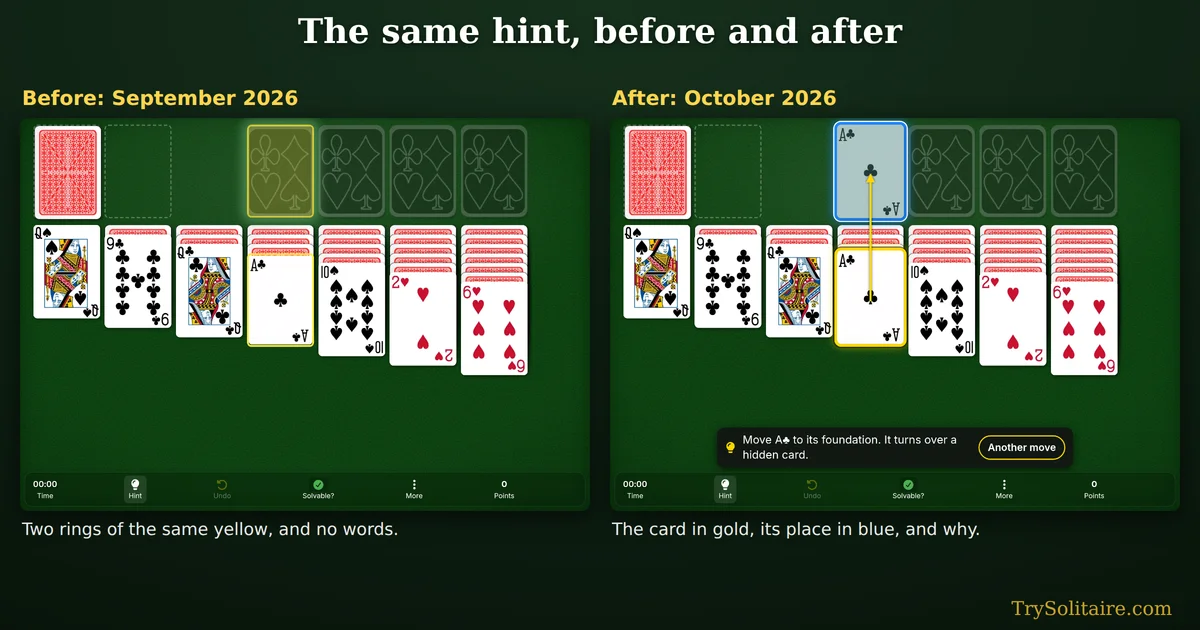
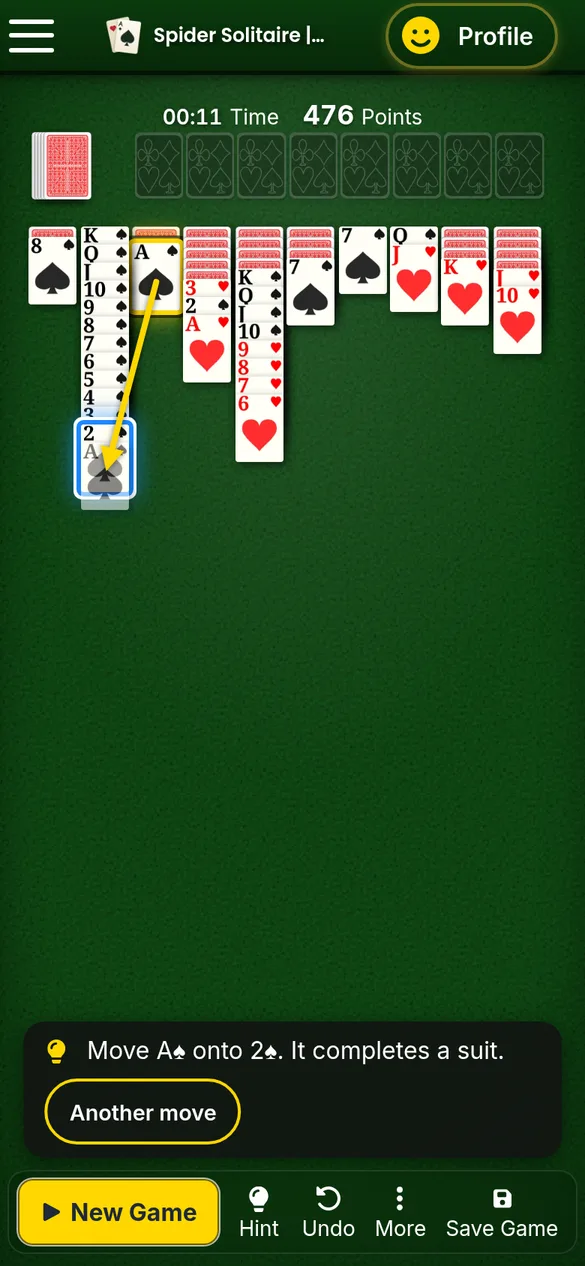
The look did not help either. The card to move and its destination wore the same yellow ring. A copy of the card flew across and covered the destination for a moment, and there were no words. On a phone, where the two cards often sit side by side, you could not tell which one should move. The picture at the top shows the first hint of the same deal in the old game and the new one.
What the New Hint Does
When you press Hint, a solver searches in the background for up to a second. In Spider it searches for up to a second and a half.
- If it finds a winning line, the hint is the next move of that line. Keep following it, and each next hint appears at once.
- If time runs out first, the hint still gives the most useful move it can find. It never takes you back to a board you have already played.
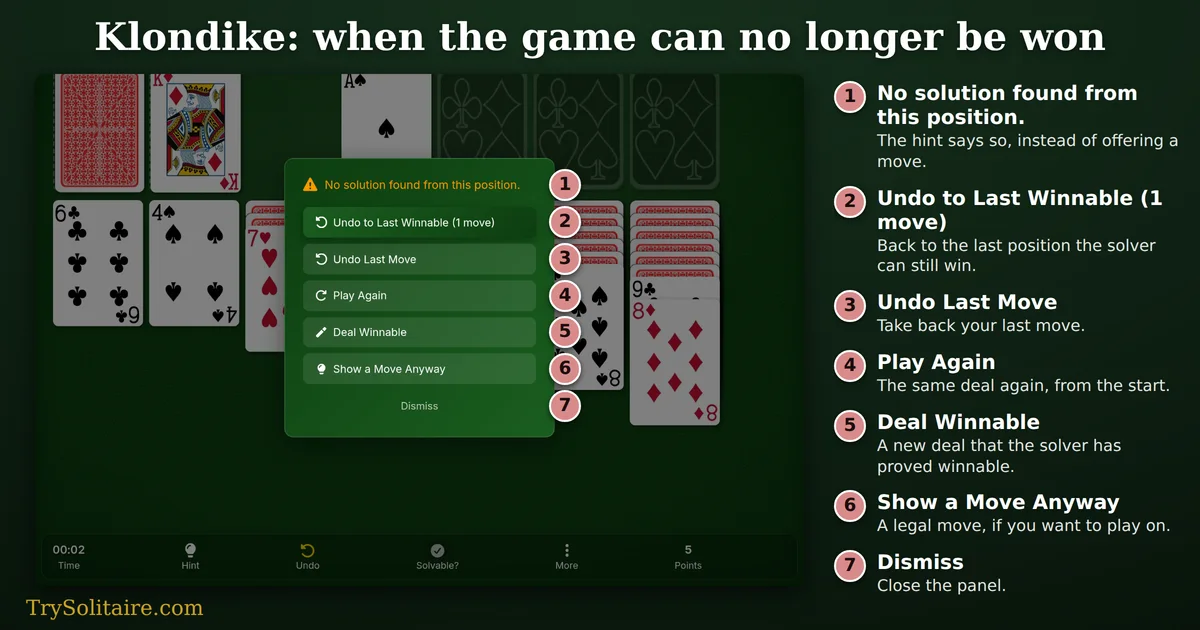
- If its search proves the game lost (Klondike and FreeCell), the hint says so instead of offering a move. A panel offers a way back: to the last winnable position when there is one, or one move back. It can also start the game again or show a move anyway.
- Spider never says a game is lost. Its search can miss a win, so it cannot prove a loss. When no useful move is left, its panel offers Undo Last Move, Restart, New Game, or a move anyway.
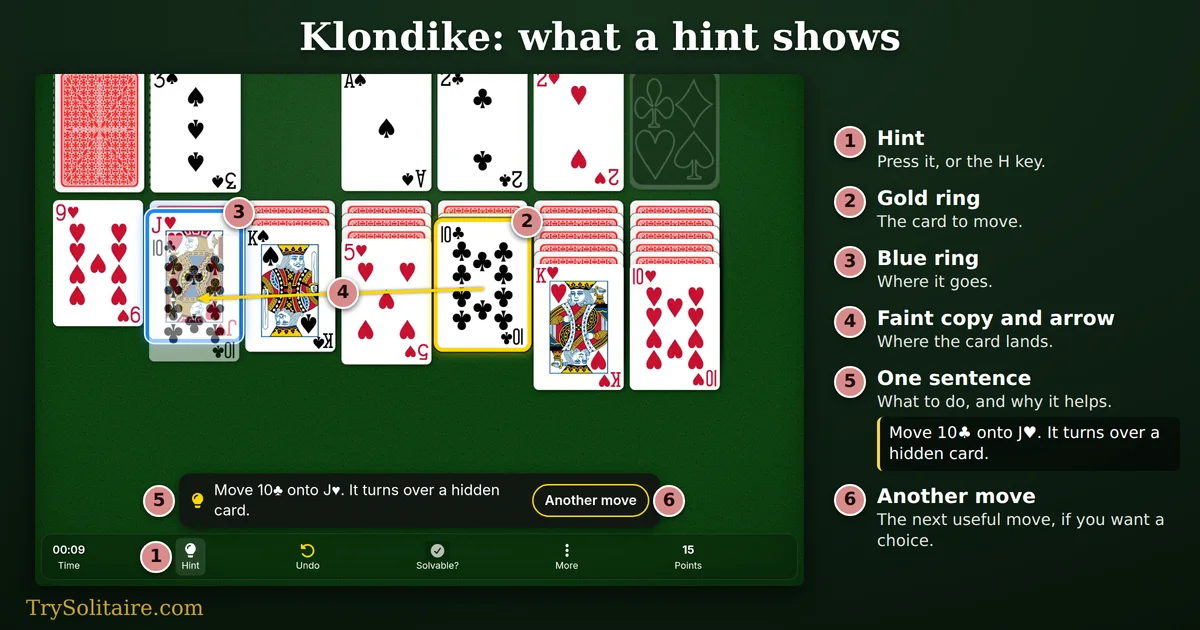
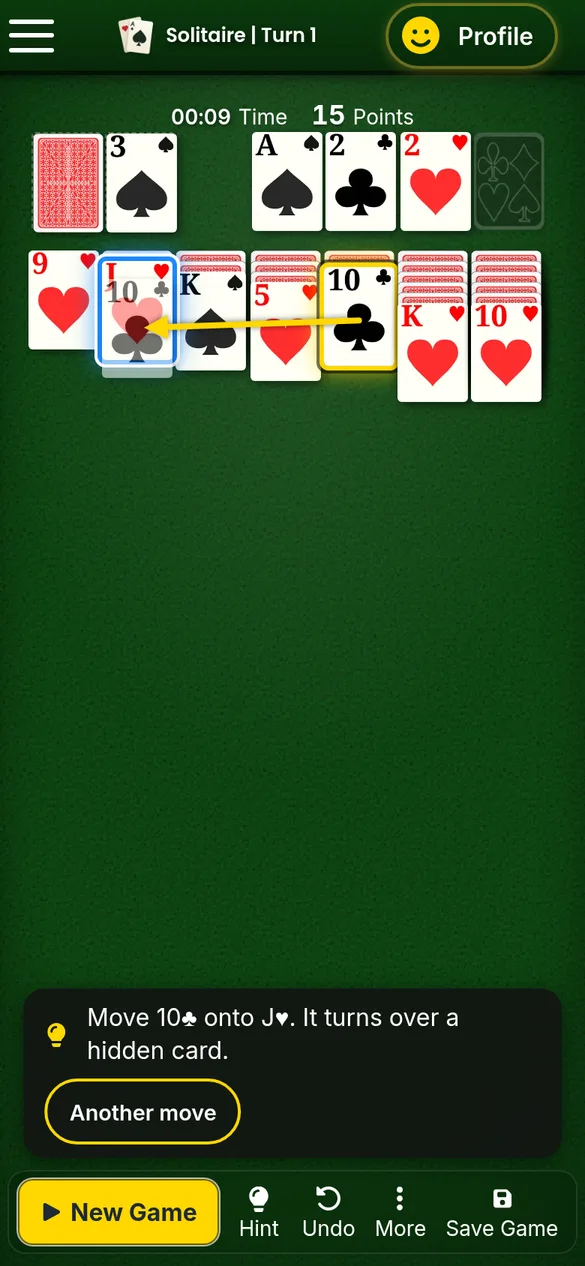
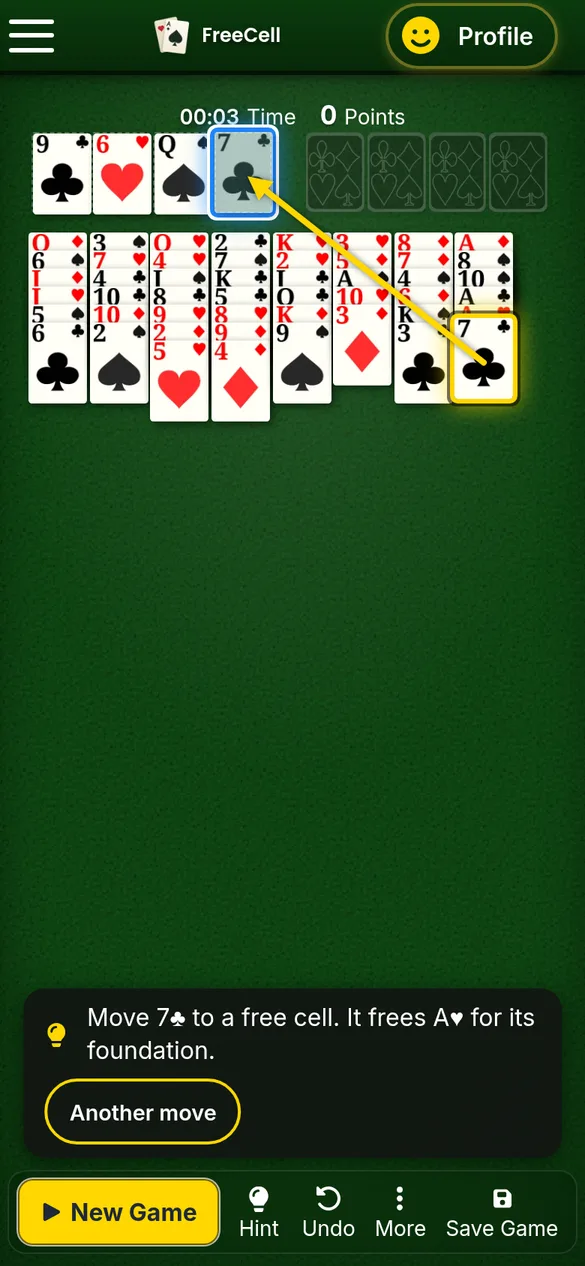
What you see:
- A gold ring on the card to move.
- A blue ring on the card or space where it goes.
- A faint copy of the card where it will land, and an arrow.
- One sentence: what to do, and why it helps.
- An Another move button, for the next useful move if you want a choice.
The hint stays for 8 seconds, or until you move. Tap the gold card to play the move, or press the H key for a hint. A hint costs no points. In Klondike, if you turn off the Solver setting, the hint still gives moves, but it never speaks of winning or losing.
The Results
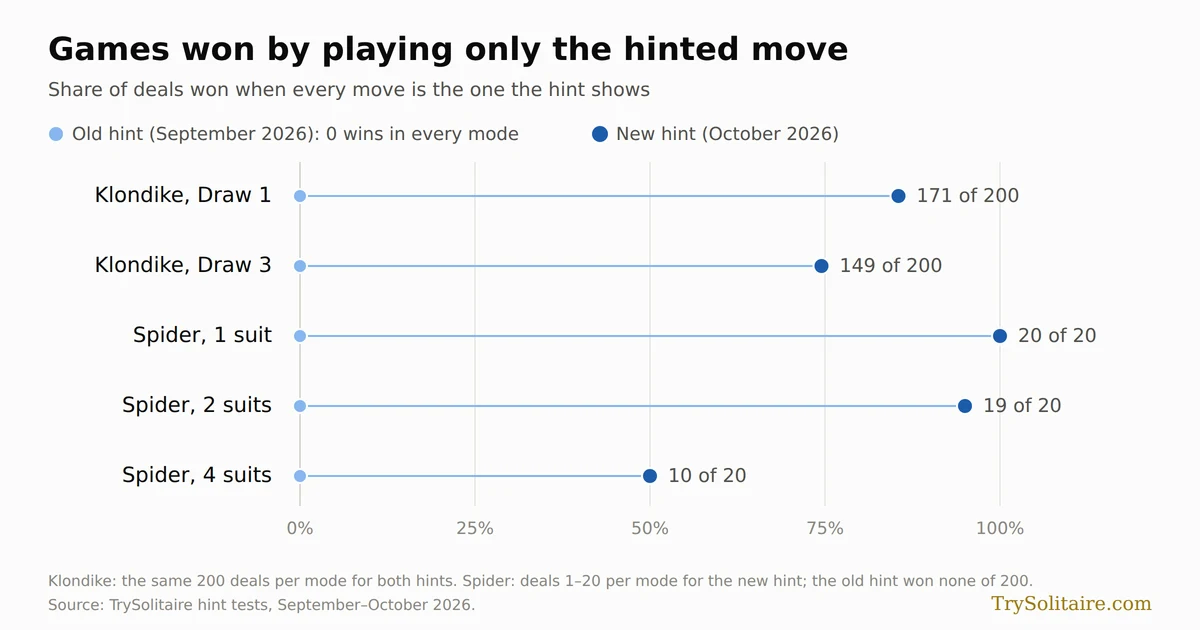
| Game | Old hint | New hint |
|---|---|---|
| Klondike, Draw 1 | 0 of 200 | 171 of 200 |
| Klondike, Draw 3 | 0 of 200 | 149 of 200 |
| Spider, 1 suit | 0 of 200 | 20 of 20 |
| Spider, 2 suits | 0 of 200 | 19 of 20 |
| Spider, 4 suits | 0 of 200 | 10 of 20 |
Klondike. In Draw 1, the hint won every deal our solver proves winnable within 5 seconds (169 of 169), and 2 deals the solver could not decide. In Draw 3, it won 147 of the 151 deals proven winnable, and 2 more. These numbers come from our design tests: a model of the game that uses the game’s solver and the same one-second search per press.
Spider. These are deals 1 to 20 of each mode, played on October 3, 2026, under the standard rule: only a run of one suit moves as a unit. Four suits is still hard, and the hint won 10 of 20. The tests searched 200,000 positions per press. A fast computer searches more than that in a second and a half, and a slower device searches fewer. So the Spider hint depends on your device. On the first six 4-suit deals, 40,000 positions per press won 3 deals, and 200,000 won 5.
FreeCell. FreeCell is not in the chart, because our large FreeCell test counted deals the solver solves, not games won by following the hint. The solver solves 1,999 of 2,000 test deals, half of them in 2.2 milliseconds or less. In the game’s own tests and in our live check below, following the hint won every FreeCell deal it played. FreeCell shows every card, so its solver knows only what you can see.
In Klondike and Spider, the solver also knows the face-down cards. That is how it can prove a deal winnable. The hint never shows you those cards. It shows only the next move.
We Also Played the Real Game
The numbers above come from test programs. On October 3, 2026, we also played the live game in a web browser. A script pressed Hint, tapped the gold card, and repeated until the game ended.
| Game | Deals | Won by the hint | How the others ended |
|---|---|---|---|
| Klondike, Draw 1 | 1–20 | 15 | 5 at the recovery panel |
| Klondike, Draw 3 | 1–10 | 8 | 2 at the recovery panel |
| FreeCell | 1–10 | 10 | — |
| Spider, 1 suit | 1–5 | 5 | — |
| Spider, 2 suits | 1–5 | 4, and deal 4 on one of three runs | see below |
| Spider, 4 suits | 1–5 | 4 | 1 at “No useful move is left” |
In Klondike, the hint won every deal that the game’s own check proved winnable: 15 of 15 in Draw 1, and 8 of 8 in Draw 3. Of the other seven deals, five were proved lost and the check could not decide two. All seven ended at the recovery panel. On four of the five lost deals, the hint first offered a few more moves, 2 to 17. We fixed that the same day: once the check has proved a deal lost, the first press of Hint opens the panel.
One 2-suit Spider deal, deal 4, gave three different results in three runs. On the first, one press of Hint just after a suit was completed showed nothing, and the script stopped. On the second, with longer pauses between moves, the hint won. On the third, from move 107 the hint moved the same few cards from column to column, and no suit was completed by move 160, where the script stopped. We fixed both faults the same day. A press of Hint now waits until a completed suit has landed. And the Spider solver now counts two boards that differ only in the order of their columns as one board, so its line never comes back to a board it has passed. Then we played 2-suit deals 1 to 5 again, and the hint won all five. It won deal 4 in 169 moves, at normal speed and with reduced motion, and no board came back. The same change made the Spider search about four times as fast, so each press now searches about four times as many positions.
What the Hint Still Cannot Do
- Win a lost deal. Some deals cannot be won. When its search proves it, the hint tells you.
- Play like a person. The hint’s line wins, but it is not always the order a person would choose. In Klondike, it now makes its moves on the board first when it can. When its next move needs a card from the stock, it still asks you to draw many times in a row.
- Beat most 4-suit Spider deals. It won 10 of 20.
- Search as far on a slow device. Spider hints are weaker on slower phones and tablets.
How to Use It
- Press Hint, or the H key.
- Tap the gold card to play the move, or move it yourself.
- Press Another move to see the next useful move.
- If a panel opens, read its first line. It tells you why there is no move, and its buttons take you back or start again.
Try it in Klondike, FreeCell or Spider. To learn how the solver decides a deal, read our solitaire solver guide. For strategy without hints, see the Klondike guide, the FreeCell guide and the Spider guide.
How We Measured
- Old hint and Klondike design tests: our hint test programs, September 30, 2026. Spider: October 3, 2026. FreeCell solver: September 30, 2026, deals 401 to 2,400. Live game: October 3, 2026.
- A deal is a numbered game. The same number always deals the same cards.
- Won means every card reached the foundations by playing only the hinted moves.
- Each old-hint game stopped at a win, a repeated board, no hint, or 1,500 moves.
- The old-hint Spider games used our old rule, which let a run of mixed suits move as one unit. That rule made the game easier, and the old hint still won nothing.
Published October 3, 2026 | TrySolitaire Blog · Play Free Solitaire